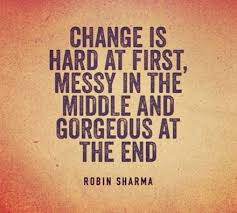
Oh My, How Hard It Is To Change!

Oh My, How Hard It Is To Change!

From Each Day A New Beginning, January 8:

“’When people make changes in their lives in a certain area, they may start by changing the way they talk about that subject, how they act about it, their attitude toward it, or an underlying decision concerning it.’ ~Joan Illsley Clarke

…Each positive change we make builds our self-esteem. Realizing that through our own actions we are becoming the kind of women (and men) we admire, gives us the strength, in fact, encourages the excitement in us that’s needed to keep changing…

I will accept an opportunity today to act as if I can handle a situation I used to run from.”

I was desperately unhappy when I joined Al-Anon. I was sure that my misery was caused by my daughter and her substance use disorder. It didn’t occur to me that it was my reaction to those circumstances that was the culprit. But when, after years of struggle, I finally did accept that I was the author of my own unhappiness, I was ready to do some of the real work of the program. Many people write me: “But what made you WANT to change?” I answer them all the same way: “I was sick and tired of being sick and tired” (of myself).

My daughter has gone in and out of recovery from SUD. My recovery, in recent years, has followed a different trajectory. And the key, of course, is being able to cut the umbilical cord and recognize that we are on separate paths.

That’s very hard for most parents, myself included. But when I see the damage that comes from NOT detaching, from staying mired in old resentments, old guilt, old unresolved stuff, I am reminded to let the past go and stay in the here and now. “Annie,” deep in her disease, has consistently tried to keep my focus on past errors, in order to justify her rage and distract her from what she needs to do now to get well.

But that’s the illness talking. I don’t take the bait anymore. I don’t engage unless it’s on a healthy level. Why not? Because it keeps us rolling around in the mud. And that’s not productive.

For a long time I welcomed rolling around in the mud. But not anymore. That’s one of the changes in myself that I’ve enjoyed. With my history, my self-esteem has always been shaky. But the tools of recovery help me learn how to adopt new attitudes about myself. And as the reading suggests, this is most often accomplished by making positive changes in my behavior.

When I do good things, they return to me tenfold. I may not get everything I want in my life. But for me to get up every day and say to myself: “You know, Marilea? You’re okay. You’re a work in progress. You just keep doing things that reinforce that self-directed goodwill, and you’ll be okay.”

Life is unfolding as my HP intended, and all will be well.

We Do Recover

Dr. Nora Volkow, director of the National Institute on Drug Abuse, has said: “I’ve studied alcohol, cocaine, methamphetamine, heroin, marijuana and more recently obesity. There’s a pattern in compulsion. I’ve never come across a single person that was addicted that wanted to be addicted. Something has happened in their brains that has led to that process.”

I picked up my tools for recovery in various 12-Step fellowships, which are at times controversial. I was reading in “Psychology Today” an article addressing this controversy. Here’s the link:

https://www.psychologytoday.com/us/blog/where-science-meets-the-steps/201211/why-the-hostility-toward-the-12-steps


I honestly think that I could have picked up some of these life lessons anywhere; Al-Anon doesn’t have a lock on teaching gratitude and acceptance. The fellowship just happens to be where I gained some tools to change my attitudes and try to live better. I learned in more than one program how to take responsibility for my own happiness and how to stop searching for validation outside of myself. I’m happy to be a member. But this is an interesting article, and explains why many people still shy away from 12-Step programs.

“Do whatever works for you—“ that’s my motto.

My Daughter/Myself

My story with Annie has always been a complicated one. A number of moms I’ve met in these rooms are double winners, like myself, and that reality only made my recovery work harder. And lengthier! This excerpt demonstrates how I was dealing with my daughter from a terribly weak position. And until I dealt with my own issues, I would be in no position to intelligently cope with hers.

Enjoy this poignant excerpt. It’s a window into my life before I surrendered to a power greater than myself, before I began reaping the rewards of my own recovery.

https://www.thefix.com/my-daughter-myself

My (Old) Achilles Heel

Guilt has been a huge stumbling block for some of us in recovery. This is true because it keeps us stuck in the problem rather than in the solution.

I, too, have struggled with multiple addictions. So when my daughter mirrored my behavior, I was stunned to see her becoming a worse version of myself. The heartache was so real, and so deep, that I carried the responsibility for it. And that miscalculation crippled my judgment in numerous ways, ways in which I knew better. But I was still stuck in the problem.

Gratefully, I’ve become more educated about substance use disorder. It’s a brain disease with many moving parts, both physical and emotional, and with the cooperation of the user, it is highly treatable. But full recovery rests there, in the hands of the suffering addict. There is much we in the family can do to help and encourage, ways to show love and support without drowning ourselves. But we do not have the power to cure our loved one.

I am so heartened by what I’m learning about SUD recovery. More family involvement, love and support can make all the difference to a struggling family member. It encourages me a great deal to see substance use awareness moving in a more positive direction. Someday shame and stigma will be relics of the past, and SUD sufferers will be treated more effectively, with intelligence and compassion.

And guilt, one of the most useless and harmful emotions there is, will be kicked to the curb.

The Many Faces of Gratitude

Though nothing can restore the years we’ve lost with Annie, I feel more and more able to embrace the life around me and revel in the gifts I’ve been given. On my gratitude list this morning: “I thought the rose bush was dead, but a little more water and it’s come back.”  Simple things—

How is it possible for me to be grateful, even, to Annie, whose illness brought me into the rooms of 12-Step recovery? How is this possible?

My unsent letter to my child:

Dear Annie,

Ironic, isn’t it, that you have become my teacher and not the other way around—teacher of life, teacher of love, and beacon of surrender.

I’m so grateful that you were born, even though at times I’ve felt otherwise. God works in mysterious ways, doesn’t he? Though you haven’t been in my life long, and not always happily, it’s been your very existence that has propelled me into a serenely spiritual life, even happiness. I never would have done the work necessary to reach this place without your inspiration.

You are my child, my teacher. As I’ve stumbled on this rocky path, my thoughts of you have guided me; they guide me still.

All that I’ve become are gifts from you, my daughter: life lessons, trial by fire. How do I honor you?

By living well—By loving well.

Mom

I Am a Child of God, and I am Worthy

From Each Day A New Beginning, CAL, November 2:

“Love is a gift we’ve been given by our Creator. The fact of our existence guarantees that we deserve it. As our recognition of this grows, so does our self-love and our ability to love others…High self-esteem and stable self-worth were not our legacies before finding this program…Had we understood that we were loved, in all the years of our youth, perhaps we’d not have struggled so in the pain of alienation.”

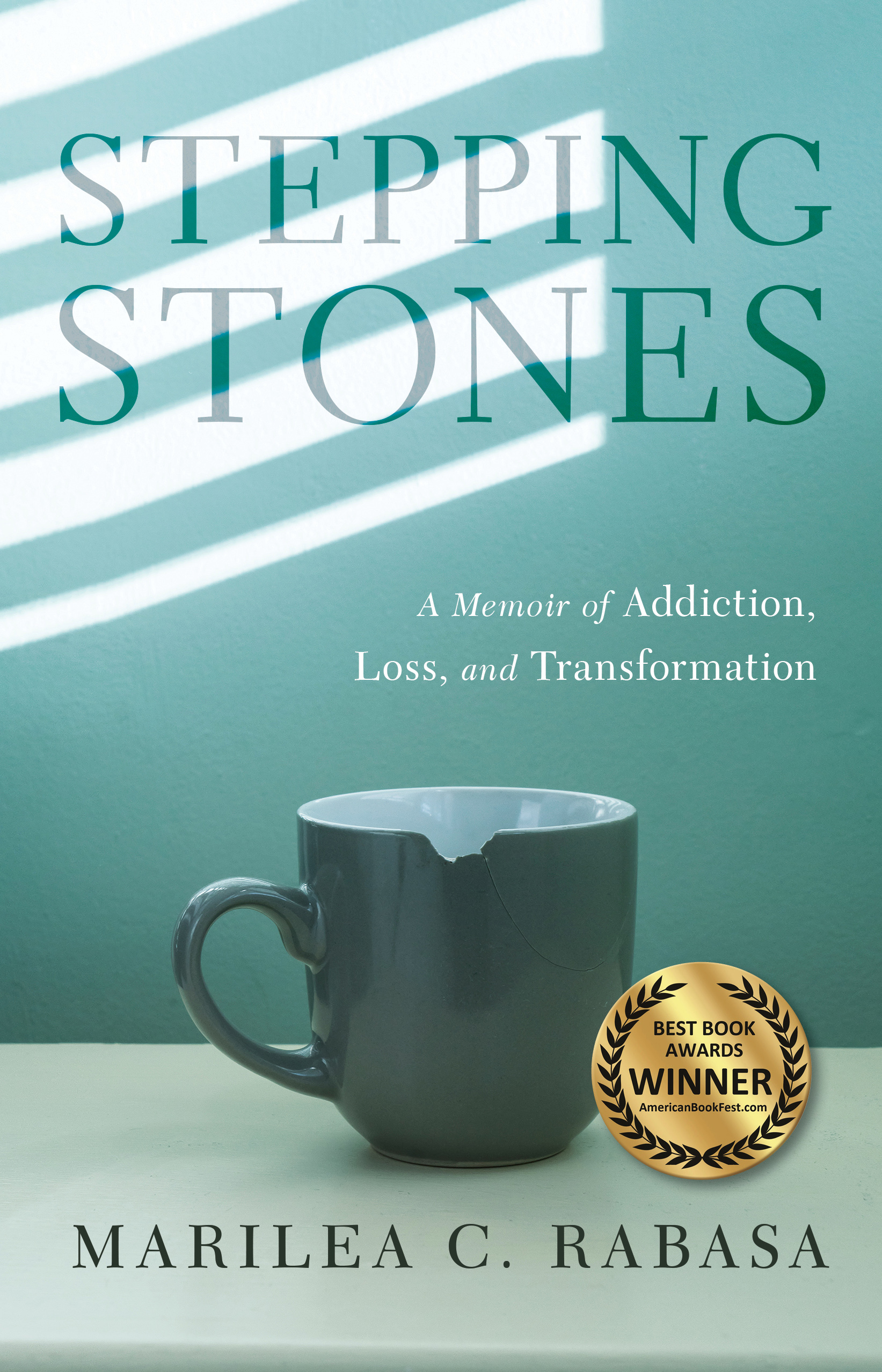
This vignette, entitled “Grace,” from my award-winning memoir, Stepping Stones: A Memoir of Addiction, Loss, and Transformation, affirms my realization that I am a child of God, worthy of love:  

    “While working… back in 1972, I spent a lot of time at a particular thrift shop… Making only about six thousand dollars a year, I was grateful to have acquired a taste for secondhand merchandise.

For twenty dollars, I bought a large print of Maxfield Par­rish’s most famous painting, Daybreak, mounted in a handsome frame. Something stirred in me as I spotted the alluring blues in an obscure corner of the shop where someone had placed the painting. It has held a prominent place over every bed I’ve slept in since that year.

I am the woman lying on the floor of the temple, one arm casually framing her face, shielding it from the sun. Columns support the temple, and there are leaves, water, rocks, and moun­tains in the background, painted in tranquil shades of blue.

Bending over me is a young undressed girl. I am in conversa­tion with her. My face feels warm and I’m smiling. The setting in this picture is one of absolute calm, beauty, and serenity.

That has been my ever-present wish: to be as watched over and cared for, as it appears that woman was.

All my life, though I wasn’t always awake and aware of it, I have been.” @2020Marilea C.Rabasa

God, in all His magnificence, has always loved me.

Out Of My Mouth

My sponsor often scolded me when I put myself down, even slightly. Until I got into recovery, low self-regard followed me most of my life. I had some bad habits that needed correcting. If I had a hard time accepting myself, how could I expect anyone else to?

Thank goodness I found the rooms of recovery before I grew too old to reap the rewards! The twelve steps, when practiced with the help of my sponsor, have brought miracles of transformation into my life. I’m so grateful that I’ve remained teachable and not too set in my ways.

I, along with millions of others in our fellowship, have found the courage to change. We only get one chance to go around the block, and it’s never too late to try to do better. My life and relationships have grown richer and more rewarding as a result.

There was a time in my life when genuine joy was a foreign concept to me. Now, upon waking, each day is a new beginning, a chance to check my attitudes, my words, and my behavior.

The three A’s: awareness, acceptance, and action. Each night before my head hits the pillow, if I’m following my program, then I know I’ve done the best that I could do. I especially need to watch what I say because words can’t be taken back and they often do much harm. So, I try to be mindful that my words reflect the best in me.

Other people can be mirrors for us, and if I pay attention, I learn through my every interaction with others what is working and what is not. My program offers an endless array of guidelines to help me make the most of my life.

My joyfulness, on any given day, springs from that.

Mindfulness

From SESH, June 27: T.H.I.N.K.

Am I thoughtful?

Am I honest?

Are my words intelligent?

Are they necessary?

Am I kind?

I love this acronym because it shows how emotions can collide with rational thinking. It also shows that even when we are being rational, we sometimes say the wrong thing. As a writer, I’m aware of the power of words—how they can persuade, or repel, how they can win friends, or lose them. I’ve done them all! When I get too emotional, I’m sure to say the wrong thing. Experience has taught me to use this acronym to weigh carefully what comes out of my mouth. To ask myself if what I say is necessary, or am I just spouting off, releasing steam like Old Faithful in Yellowstone? Am I being honest, or are my words brutal and tactless? Do I care how my words might affect the other person? Am I so emotional, in the moment, that my words might appear unintelligible? And most of all, do my words demonstrate kindness towards the other person?

Of all those terms, kindness for me is the most far-reaching and important. No matter what happens to us in our lives, no matter how deeply we are humbled by our circumstances and shortcomings, if we can remain kind in the face of everything, then that says a lot about our character.

“Thoughts become words. Choose the good ones!”

Staying Out Of The Weeds

Before I went into recovery, I was pretty lost. On the outside, my life seemed to be rolling along well. But on the inside, I was insecure and sad. I dealt with these feelings in unhealthy ways, but didn’t feel much pressure to change them. I never missed a day of work, and I appeared to be fine. But appearances can be deceiving. Nothing had yet occurred to call my choices into question. Nothing had happened yet to push me out of my complacency.

But when my middle child fell victim to substance use disorder, after I had tried and failed over and over again to help her, I broke. The carefully manicured life I had been living was a treasured glass from my cupboard, smashed onto the kitchen floor. Many little shards, and some big ones. I cut my fingers cleaning it up.

My recovery fellowship comes with a philosophy that teaches me many different things. And one of those things is to forgive myself and others for the transgressions we inevitably commit in our lives. Our common humanity dovetails at every meeting I go to, where we encourage ourselves to face our defects, let them go, and move on.

For years, I held on to mine to punish myself for my part in Annie’s disease, and most importantly, for failing to “save” her. I have learned, gratefully, that my daughter suffers from substance use disorder, as do I, and I could no more save her from it than if she’d had diabetes. I simply don’t have that power.

So I try to stay away from martyrdom and self-pity, because neither of those feelings will help Annie get well, and they hurt me a great deal. That’s where the weeds are. They muddy the waters; they keep me angry and sad. When I steer clear of them, it takes some of the sting out of losing my daughter. I can more easily open my heart to what remains in my life.

The miracle of my recovery is that, like a gentle breeze blowing away the clutter of remorse, my eyes can see my life through another lens now, one full of gratitude, humor and love. The fruits of my recovery rest on these three things.

“We forget that the depths teach us how to better appreciate the heights.”