Detachment

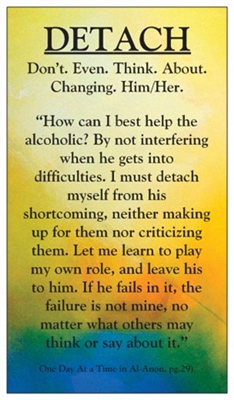
For mothers of substance users, detachment is one of the hardest tools to use. We are inevitably joined through years of raising, nurturing and loving our children as best we could. And when things go so horribly wrong as they do with substance use disorder, it’s only natural to question ourselves and how we raised them.

Self-blame is common, as we take on too much responsibility for our child’s illness. I myself overcompensated where I shouldn’t have. I felt guilty and that guilt crippled my judgment. I became an enabler, and that prevented my daughter from learning from the consequences of her (drug-induced) behavior.

Thankfully, I’ve had years of recovery work to learn how to detach from the pain of watching my daughter self-destruct. I did send her to several rehabs and hoped that a sound upbringing and family love would turn her life around. But ultimately the choice to recover is hers alone.

I wish I had the power to change her. I wish things were different. But I have two other children who were raised the same way, and they are blessings in my life. I’ve stopped blaming myself, and I’ve learned to accept a situation I don’t have the power to change. I detach. I move away from obsessing about the pain of losing her. And I focus on the many good things that remain. When I try to keep my attitude positive, my life works better for me.
Gratitude For What Remains

From Each Day A New Beginning, September 21:

“Praise and an attitude of gratitude are unbeatable stimulators…we increase whatever we extol.” ~Sylvia Stitt Edwards

“What outlook are we carrying forth into the day ahead? Are we feeling fearful about the circumstances confronting us? Do we dread a planned meeting? Are we worried about the welfare of a friend or lover? Whatever our present outlook, its power over the outcome of our day is profound. Our attitude in regard to any situation attracting our attention influences the outcome. Sometimes to our favor, often to our disfavor if our attitude is negative…The more we lamented what life “gave us,” the more reasons we were given to lament. We got just what we expected. We still get just what we expect. The difference is that the program has offered us the key to higher expectations.”

Or different ones.

I expected my daughter to respond favorably to all the support she was getting from several rehabs and the love of her family. She did for a while. And then she didn’t. Right now substance use disorder has separated her from her friends and loved ones. It’s been her choice to walk away.

I lamented losing her for a long time. And then I got tired of letting this very real tragedy take control of my life. One day I woke up and asked myself a question: do I want to go on being sad for the rest of my life? Or do I want to learn how to live well?

There are too many other people in my life who need me to be well. If I went down the tubes with my daughter, then substance use disorder would claim another victim. I’m too mad at this miserable disease to give it that satisfaction.

So I decided to try to learn how to really live well. Yes, I’ve lost my daughter. And I will always grieve the loss of her. But I have another daughter, and a son, and grandkids, and friends…I have good health…a wonderful guy…and the good sense to feel humbly grateful for all these blessings.

When I keep my attention on all that, my inner spirit glows with contentment.

Pass it on.

I’m Glad I Stayed

“’I came for a quick fix and found a way of life.’ ~Bertie P., Florida

As I look back, when I walked through the doors of Al-Anon, I had planned to stay long enough to find out how to get the miracle of sobriety in my home. I’m still there!

I was broken spiritually, emotionally, and physically. I had given up on everything and everyone. A friend dragged me to Al-Anon, but I was sure it was hopeless.

After my first meeting, I was still very angry. How could all those people be happy and smiling? Their homes could not be as bad as mine. Fortunately, I wanted to laugh and smile too. A member, who later became my sponsor, took an interest in me as a newcomer, and I kept coming back.

The slogans and all the tools annoyed me, and I didn’t share. Did I ever have a closed mind! But…I kept going…

I started taking care of myself and gave the alcoholic a choice to get help or go his own way. Five years later, the real miracle was finding me…I learned how to change my life and really live.”

Wishing/hoping/praying that my daughter will tire of her life and seek recovery is holding myself hostage to something I have no control over. And I don’t want to be a hostage. I want to be free. My recovery program has given me the tools to live my life unencumbered by other people’s choices.

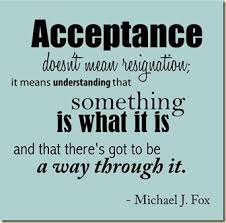
“God, grant me the serenity to accept the things I cannot change, the courage to change the things I can, and the wisdom to know the difference.”

Loosen Your Grip!

From Survival To Recovery, page 268:

“Living fully requires enough trust to release our manipulative, tight-fisted control of life, for only then can we accept the guidance of a Power greater than ourselves. For adult children of alcoholics, our damaged, devastated trust has to be healed and nurtured bit by bit until we feel safe enough to truly let go and let God. Trust does not come from reading a book, however inspired, but from experiencing new relationships in which we are trusted and we can learn to trust those around us…If we willingly surrender ourselves to the spiritual discipline of the Twelve Steps, our lives will be transformed…Though we may never be perfect, continued spiritual progress will reveal to us our enormous potential…We will laugh more. Fear will be replaced by faith, and gratitude will come naturally as we realize that our Higher Power is doing for us what we cannot do for ourselves…”

“We will laugh more.”  How can I, beset by depression and instability for many of my years, come to revisit my life now from another perspective? How have I learned how to laugh and see the comedy in things? What has enabled me at last to live well and be happy?

Being in the rooms.

But I hasten to add that we can learn the same tools elsewhere: the tools of letting go and accepting what we can’t change; the tool of gratitude; the tool of detachment and understanding our personal boundaries in relation to our substance user. There are many places where we can pick up these life skills: from our family, friends, church, from our own life experiences…

I might have been luckier, like many of you, and learned these tools in a happy, functioning family when I was growing up. But I learned them later.

And it’s never too late to learn how to be happy.

White knuckling it through life is exhausting. Different methods to relax work for different people. Yoga, prayer, knitting, running, reading, listening to music—the list is endless. The best thing for me to relax is the Serenity Prayer. It has become my mantra:

“God, grant me the serenity

To accept the things I cannot change,

The courage to change the things I can,

And the wisdom to know the difference.”

I embrace this prayer in big and little ways every day. Its wisdom keeps me right-sized and humble, while at the same time encouraging me to make changes in my life that are within my reach.

We are all challenged, of course, by the last line. That’s why I keep going back to recovery meetings!


The Healing Power Of Humor

From Hope for Today, April 6:

“…Today my sense of humor is a natural reflection of who I am. I experience the world through smiles and laughter rather than through bitter smirks. I share joy with others rather than seek company for my misery. I help others heal rather than attack them. I allow my sense of humor to unfold naturally, just the way it was meant, and I watch the wonderful results as my Higher Power works through me toward a higher good.”

Finding my sense of humor has been a reflection of how I’ve changed in recovery. I’ve worked through my grief around my daughter and continue to do so every day. But the darkness has receded. Somehow it’s not as heavy to carry as it used to be. It seems lighter. I’ve gained perspective from years of reading and writing, and listening to other peoples’ stories. Being able to laugh, and cease to take myself too seriously, has eased my journey through this frightening tunnel. I can see the light at the end of it.

At times I wondered if I would ever laugh again, but my Higher Power wanted me not only to survive but to do so joyfully. There are many other people in my world, and my recovery spills over onto them in countless ways.

Cultivating a healthy sense of humor keeps me right-sized; I stay small and HP stays big. Then I don’t get in my own way so much!

A Quiet Mind

“Place yourself in the middle of the stream of power and wisdom which animates all whom it floats, and you are without effort impelled to truth, to right and a perfect contentment.“ ~Ralph Waldo Emerson

From Courage to Change, September 4:

“As we let go of obsession, worry, and focusing on everyone but ourselves, many of us were bewildered by the increasing calmness of our minds. We knew how to live in a state of crisis, but it often took a bit of adjustment to become comfortable with stillness. The price of serenity was the quieting of the constant mental chatter that had taken up so much time; suddenly we had lots of time on our hands and we wondered how to fill it.”

Over time, I’ve learned how to “be still in the stream.” It took a long time for me to accept my powerlessness. But obsessing over my daughter and living in all her drama was threatening my health. I was suffering from severe PTSD and endured many other negative consequences in my life as a result of my constant worry over something I couldn’t control.

So, I finally took the first three steps in my recovery program. It was hard to do that because I felt that letting go was giving up on my daughter. Not loving her anymore. But that’s not how I feel now.

Once, not so long ago, Annie was a loving daughter to me, a college graduate with her whole life ahead of her. Then, like the great cosmic crapshoot that afflicts millions of families, she fell out of her life and into substance use disorder. She’s been lost to us all for a long time now.

But my daughter, not the addict that lives in her body, would want me to reclaim my life as I have, and learn to be happy.

I believe this with all my heart.

The Elusive Butterfly

From Each Day A New Beginning, June 18:

“’…we could never learn to be brave and patient if there were only joy in the world.’ ~Helen Keller

We chase after joy, like a child after a firefly…”

Yes I did, all my life, and then I changed. I stopped chasing the butterfly, not because it was a waste of time, but because my time could be better spent on other things.

In a quote from Cathy Hull Taughinbaugh’s new book, The Compassion Antidote:

“While you may feel your happiness or well-being depend on what your child does or doesn’t do, the more you can focus on yourself and your happiness the better…And the more you work on yourself, the better off your child will be—now and in the future…You will then become a role model for your child. She will see you not just as her parent, but as a strong person who can weather the storms that life throws at her.”

Our children are watching. The suffering in my family has gone on for over twenty years. But if I can turn my sadness and grief into lessons in resilience and hope for the rest of my family, then it was time well-spent.

Spiritual Levitation

From Hope for Today, May 20:

“The serenity I am offered in Al-Anon is not an escape from life. Rather it is the power to find peacefulness within life.

Al-Anon does not promise me freedom from pain, sorrow, or difficult situations. It does, however, give me the opportunity to learn from others how to develop the necessary skills for maintaining peace of mind, even when life seems most unbearable…

Serenity is not about the end of pain. It’s about my ability to flourish peacefully no matter what life brings my way.”

In the movie, “The Shack,” Mac has a dream and in it he meets God. Mac had recently lost his young daughter, and in his anger and bitterness he lashed out at God. Who else to blame? God (a woman in the movie) came right back at Mac with Her own defense: She didn’t orchestrate all the misery on earth: Aleppo, slaughter in Ukraine, children starving in Nigeria. “Don’t blame me for all that,” She said.” My purpose is to help you rise above it.”

Al-Anon has the same purpose in my life. God doesn’t have the power to return my daughter to me. But if I continue my daily practice of gratitude, accept what I don’t have the ability to change, and have faith that God’s plan is unfolding for a greater good than I may ever see, I can live peacefully and even joyfully, savoring all the goodness that is in my life. It’s my choice.

An Important Distinction

I was reading about one of my favorites, Naomi Judd, and how she sadly died by suicide recently. This is what her daughter, Ashley, said about her death:

“When we’re talking about mental illness, it’s very important to be clear and to make the distinction between our loved one and the disease,” she continued. “It’s very real … it lies, it’s savage.”

Hmmm…

I believe that. We all know how substance use disorder can change our kids: change their minds, change their lifestyle, change the values we taught them. In my daughter’s case, as long as drugs were flooding her system, she ceased to be the Annie I raised.

So yes, I make the distinction Ashley has called for. And I pray that someday the general public will have as much compassion for our lost children. I remember my daughter before this disease took her away from me. And I take comfort in those memories—because I can separate her from her disease.