“One day you finally knew what you had to do, and began, though the voices around you kept shouting their bad advice — though the whole house began to tremble and you felt the old tug at your ankles. ‘Mend my life!’ each voice cried. But you didn’t stop. You knew what you had to do, though the wind pried with its stiff fingers at the very foundations, though their melancholy was terrible. It was already late enough, and a wild night, and the road full of fallen branches and stones. But little by little, as you left their voice behind, the stars began to burn through the sheets of clouds, and there was a new voice which you slowly recognized as your own, that kept you company as you strode deeper and deeper into the world, determined to do the only thing you could do — determined to save the only life that you could save.”
How eloquently she describes the convergence of conflict with awareness and resolution in our lives. As “the stars began to burn through the sheets of clouds,” my world became brighter and more light-filled. As I shed the depression that used to be my constant companion, I embraced the idea that I could be as happy as I made up my mind to be.
“’Somewhere along the line of development we discover what we really are, and then we make our real decision for which we are responsible. Make that decision primarily for yourself because you can never really live anyone else’s life, not even your own child’s. The influence you exert is through your own life and what you become yourself.’ ~Eleanor Roosevelt”
Through my recovery work, I’m learning to take better care of myself. I’m making wiser choices, living better, and embracing my life. Firm boundaries, healthy perspectives, daily gratitude are just a few of the tools that help me live well. In this way I’m trying to be a good example to those who come after me.
We all leave footprints somewhere. We have stories to tell. We all leave a legacy. May we all find some level of recovery as we weather the storm of substance use disorder. Our newer, healthier selves are a worthy legacy to pass on to the next generation. This is how I honor Annie’s memory, and this is how I will always love her: by living well myself.
Relying on God, however we understand God’s presence, is foreign to many of us. I was encouraged from early childhood to be self-reliant. Even when I desperately needed another’s help, I feared asking for it. When confidence wavered, as it so often did, I hid the fear—sometimes with alcohol, sometimes with pills or too much food. Sometimes I simply hid at home. My fears never fully abated…Slowly and with practice it became easier to turn within, to be God-reliant rather than self-reliant.”
There’s a saying in the Program that “our best thinking got us here (into the rooms of recovery).” And it’s so true! I joke at meetings that I’ve always been “CSR,” compulsively self-reliant.” I have been for much of my life, afraid to ask for help and even more afraid to accept it. As a child I had to rely on myself for so many things, and that became a survival strategy. But as an adult, that very façade of strength can become a terrible defect. Appearing to be a formidable wall of arrogance, it only served to isolate me and separate me from my peers. I had to tear down that wall.
And when I did, when I found the ability to bare my fears and vulnerabilities and ask for help when I needed it, I found my humanity. My faith in a power greater than myself enabled me to let go of my self-reliance and join hands with others as we reached out and helped one another.
It hasn’t removed the problems from my life. But it has made facing and living with them so much easier.
“They sicken of the calm, who knew the storm.” ~Dorothy Parker
Do I see myself here? Somewhat, if I’m honest, as cynical as that quote is. Maybe in the beginning I was addicted to the drama of Annie’s substance use disorder. That—and all the martyrdom I subjected myself to. But this did not bring me happiness. There are a number of ways, I have learned, to stay involved with an addicted child—ways that might have helped us both navigate this illness better. But for a long time I was stuck and didn’t know how to free myself of the downward spiral.
Over time, my obsession broke me down and wore me out. I do enjoy the peace in my life now, though I still experience some PTSD. So many years, it seems, of struggling to help her, and then for both our sakes, letting go of the struggle to save her. Addressing once and for all my own substance use—so that my presence could benefit my other loved ones. Don’t think for a moment that I don’t feel the pain of losing Annie. I do. The trauma of losing a child, to whatever illness, never goes away. But, in my experience, it isn’t so heavy to carry. It feels lighter now. Hang in there, Moms. Many things are resolved with better education and the passage of time. Keep loving yourselves and the world around you. Love is the great healer of all things!
“Loving, like prayer, is a power as well as a process. It’s curative. It is creative.” ~Zona Gale
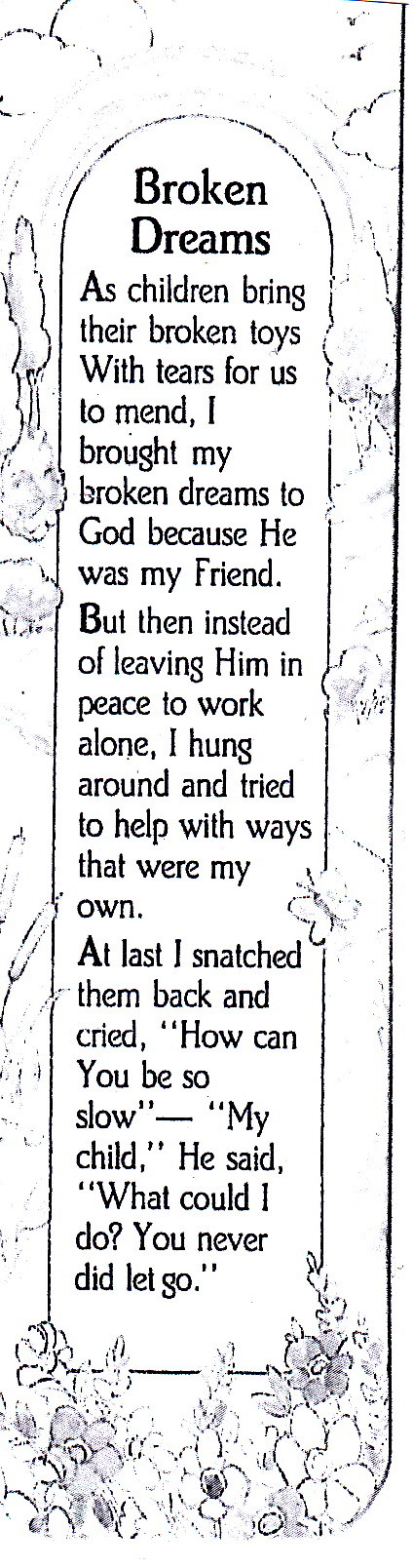
This poem addresses the idea of letting go, as opposed to clinging to, much of the negativity in my life—much of what used to weigh on me and drag me down into depression.
Detachment is a skill that allows me to create a safe distance between myself and my daughter. I have learned that if I don’t, I will be swallowed up in her black hole before I know it. As a parent, I’ve often felt that I didn’t deserve the gift of detachment. But I do. I did the best I could with what I knew at the time. I’ve learned to forgive myself for any mistakes I made with my daughter. It took a long time, but this was an important step in my recovery. Until I did that, I risked being forever enmeshed in her pain and the mess of her life as it is now.
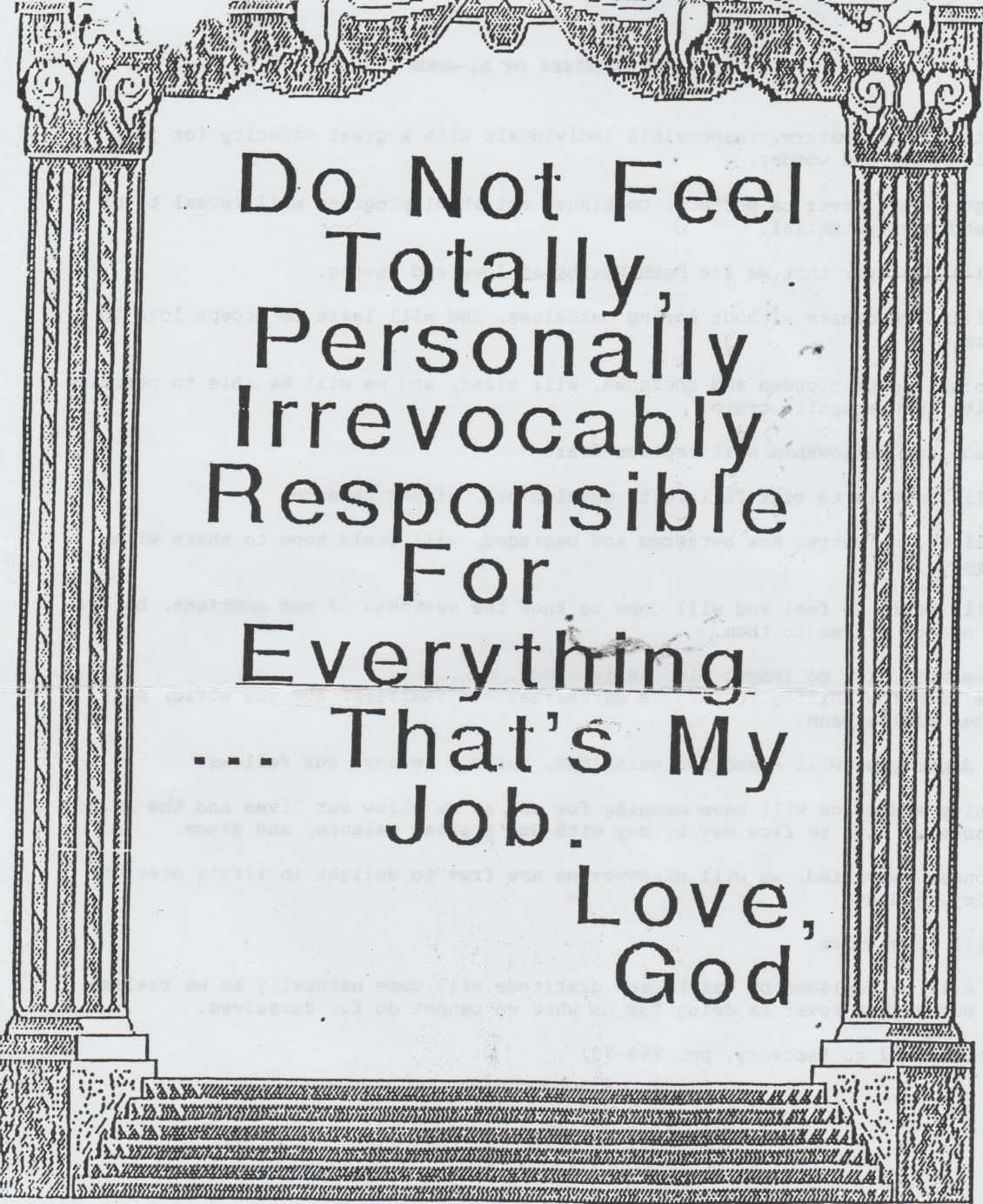
Once I could reach some level of detachment, I was freer to work the steps. In hindsight, I see now why I couldn’t really do the first three steps in a more timely manner. I simply had not let go of my responsibility in her life, my importance in her life, and therefore my need to fix her life.
I needed to be humbled—in the best sense of the word.
“Living well is the best revenge.” ~George Herbert
I’ve received many emails from moms asking me how I cope with the living death of Annie’s substance use disorder. Many of my friends here know the hellish limbo I’m living in, without any resolution or closure. But I have found a way to cope better and move on with my life. This is what I tell them:
“I put my sadness in a back drawer and close it. Then I look at what’s in my front drawers every morning. I have so many wonderful things to be grateful for. Instead of focusing on my problems, I try to keep my mind on the solutions. This is how I live. It keeps me humble, grateful, and glad to be alive. I will never forget that Annie was once a beautiful, creative young woman. I honor her memory in this way, and I truly believe she would want me to live well and be happy. In this month of love, I celebrate my daughter with happy memories, hopes for her future, and confident in mine.”
“Serenity? What is that? For years I was like a weather vane that spun around according to the air currents that other people generated… I attributed these mood swings to nervousness, lack of assurance, and whoever else occupied the room at the time. Serenity always seemed beyond my control… Where does this serenity come from? It comes from trusting that everything in my life is exactly as it should be. It comes when I choose to care for myself rather than to fix someone else…
THOUGHT FOR THE DAY: I am powerless over many things, but my serenity is not one of them.”
“Trusting that everything in my life is exactly as it should be…” That’s the hard part, because everything in my life is not great. My daughter Annie is lost to me and has been, on and off for twenty years. How does one learn to live with that?
Everyone is different, but I find serenity by focusing on my blessings. They’re all around me: my other children, my grandchildren, and nature. The salt air just blows me away with its fragrance, and the trees in this rain forest are already budding a little. My friends and my partner Gene are my daily supports. And God—he pilots my ship. In spite of my loss, I find myself saying all the time, and feeling sincerely in my heart, that life is good. And I’m filled with the elevating power of gratitude.
Like any good habit, I have to practice it every day: my gratitude journal; the therapy of writing down my stories. And ever so gradually over the years—I don’t remember exactly when—my dark world started to get brighter. I began to laugh more. I found joy in my grandchildren—not consolation. And I knew—though I’ve lost a piece of my heart—that I would find a way to get past the heartache.
    “I want to feel myself part of things, of the great drift and swirl; not cut off, missing things…” ~Joanna Field

                                            Reunion
In 2006 my partner, Gene, and I went to my fortieth high school reunion. This was in a town where appearances mattered above all else, where I’d learned growing up that how I felt was secondary to how I looked. And that year, I was looking good. I hadn’t been in touch with any of the people I might see there. So they didn’t know any of the details of my life. All they would see was a pretty fifty-eight year old with her handsome boyfriend. I went to say to a few of them, “See? You didn’t destroy me after all. I’m still here.” My first boyfriend, John, was there with his friend, another kid from the popular clique that had blackballed me in junior high. He was still a handsome man, and I remembered why I was attracted to him back in eighth grade. It was odd seeing him there, with all those years between us. To my surprise, he and his friend sat down at the same table with us—right across from us. I didn’t know anything about him, and right there was an opportunity for him to tell me about his life. But I was disappointed. His eyes were carefully averted—drawn to other people like magnets all over the room. No “Hi there, Marilea. Look at you! What have you been up to in all these years?” No curiosity about me at all. Not even a polite greeting or nod. I might as well have been invisible. But then again, Gene was sitting next to me, and they might have found that intimidating. He was my convenient shield. Another friend of John’s sat down on the other side of him, and John craned his neck in that direction, excitedly asking him all about the Patriots’ upcoming season. Gene and I left the table unceremoniously, moved around a bit, chatting here and there. We could not get out of that building soon enough. I felt like I didn’t belong there, like an outsider, which I was in a way. I wasn’t a “townie” anymore; I had defected four decades earlier. When I left that town I rarely looked back, disconnecting myself as I frequently did throughout my life. It represented so much pain and angst for me that I needed to get away. For a while I kept up with the few friends I had, but even that grew difficult with my moving around so much. Though it was fun to see some familiar faces many years later, going to my high school reunion felt awfully superficial to me. I didn’t really know anything about the people there, and they knew even less about me. Sometimes going to a reunion is like looking at a display case in a museum: you often know nothing about the work that went into it.
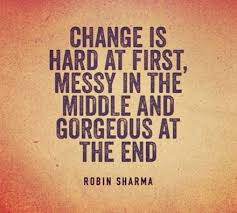
“’When people make changes in their lives in a certain area, they may start by changing the way they talk about that subject, how they act about it, their attitude toward it, or an underlying decision concerning it.’ ~Joan Illsley Clarke
…Each positive change we make builds our self-esteem. Realizing that through our own actions we are becoming the kind of women (and men) we admire, gives us the strength, in fact, encourages the excitement in us that’s needed to keep changing…
I will accept an opportunity today to act as if I can handle a situation I used to run from.”
I was desperately unhappy when I joined Al-Anon. I was sure that my misery was caused by my daughter and her substance use disorder. It didn’t occur to me that it was my reaction to those circumstances that was the culprit. But when, after years of struggle, I finally did accept that I was the author of my own unhappiness, I was ready to do some of the real work of the program. Many people write me: “But what made you WANT to change?” I answer them all the same way: “I was sick and tired of being sick and tired” (of myself).
My daughter has gone in and out of recovery from SUD. My recovery, in recent years, has followed a different trajectory. And the key, of course, is being able to cut the umbilical cord and recognize that we are on separate paths.
That’s very hard for most parents, myself included. But when I see the damage that comes from NOT detaching, from staying mired in old resentments, old guilt, old unresolved stuff, I am reminded to let the past go and stay in the here and now. “Annie,” deep in her disease, has consistently tried to keep my focus on past errors, in order to justify her rage and distract her from what she needs to do now to get well.
But that’s the illness talking. I don’t take the bait anymore. I don’t engage unless it’s on a healthy level. Why not? Because it keeps us rolling around in the mud. And that’s not productive.
For a long time I welcomed rolling around in the mud. But not anymore. That’s one of the changes in myself that I’ve enjoyed. With my history, my self-esteem has always been shaky. But the tools of recovery help me learn how to adopt new attitudes about myself. And as the reading suggests, this is most often accomplished by making positive changes in my behavior.
When I do good things, they return to me tenfold. I may not get everything I want in my life. But for me to get up every day and say to myself: “You know, Marilea? You’re okay. You’re a work in progress. You just keep doing things that reinforce that self-directed goodwill, and you’ll be okay.”
Life is unfolding as my HP intended, and all will be well.
Before I went into recovery, I was pretty lost. On the outside, my life seemed to be rolling along well. But on the inside, I was insecure and sad. I dealt with these feelings in unhealthy ways, but didn’t feel much pressure to change them. I never missed a day of work, and I appeared to be fine. But appearances can be deceiving. Nothing had yet occurred to call my choices into question. Nothing had happened yet to push me out of my complacency.
But when my middle child fell ill with substance use disorder, after I had tried and failed over and over again to save her, I broke. The carefully manicured life I had been living was a treasured glass from my cupboard, smashed onto the kitchen floor. Many little shards, and some big ones. I cut my fingers cleaning it up.
My recovery fellowship comes with a philosophy that teaches me many different things. And one of those things is to forgive myself and others for transgressions inevitably committed in our lives. Our common humanity dovetails at every meeting I go to, where we encourage ourselves to face our defects, let them go, and move on.
For years, I held on to mine to punish myself for my part in Annie’s disease, and most importantly, for failing to “save” her. I have learned, gratefully, that my daughter suffers from substance use disorder, as do I, and I could no more save her from it than if she’d had diabetes. I simply don’t have that power.
So I try to stay away from martyrdom and self-pity, because neither of those feelings will help Annie get well, and they hurt me a great deal. That’s where the weeds are. They muddy the waters; they keep me angry and sad. When I steer clear of them, it takes some of the sting out of losing my daughter. I can more easily open my heart to what remains in my life.
Staying in the weeds prevents me from changing and growing. My recovery fellowship provides the tools to accomplish those two things—with gentleness and kindness. It’s hard, hard work. But when I see positive results in real time, I’m encouraged to keep at it. There’s no graduation from this school of life.
The miracle of my recovery is that, like a gentle breeze blowing away the clutter of remorse, my eyes can see my life through another lens now, one full of gratitude, humor and love. The fruits of my recovery rest on these three things.