“Living Well Is The Best Revenge”

I’ve received many emails from moms asking me how I cope with the living death of Angie’s heroin addiction. She’s neither dead nor alive. Many of my friends here know the hellish limbo I’m living in, without any resolution or closure. But I have found a way to cope well and move on with my life. This is what I wrote back:


“I put my grief in a back drawer and close it. Then I look at what’s in my front drawers every morning. I have so many wonderful things to be grateful for. Instead of focusing on the problem, I try to keep my mind on the solution. This is how I live. It keeps me humble, grateful, and glad to be alive. I honor Angie’s memory in this way, and I truly believe she would want me to live well and be happy. Blessings to you, Mom.”


The Power Of Faith


From Hope For Today, June 13:

“…What I had overlooked in Step Two was the word ‘Power.’ The day I started placing my attention on that Power instead of on insanity, I began to see miracles in my life. One such miracle was my ability to talk about my fears in Al-Anon meetings. Other miracles included taking the Twelve Steps that lead me to serenity, and engaging in the process of forgiving and healing.”

It has taken many years of hearing Step Two read at meetings for me to really hear the word ‘Power.’ Now I realize how much more awesome my Higher Power is than this disease. That power has always kept me from tumbling into the chasm.

Before recovery, I was spiritually bankrupt. I had no faith in anyone other than myself. But that wasn’t working for me: I needed to bet on another horse. As I slowly accepted that I was powerless over other people, places, and things, it became easier for me to bring God into my life and let Him take over. Suddenly, I felt much lighter.

Instead of dwelling in fear, today I am striving to pass on the miracles of recovery to my children and grandchildren. With faith and hope in my heart, I look forward to getting up every day. I’m just glad I stuck around long enough for the miracle to happen.


Is It Working For You?

From The Forum, June, 2015:

“The Suggested Preamble to the Twelve Steps have been the most helpful in my recovery: ‘We believe alcoholism is a family illness and that changed attitudes can aid recovery.’ That is to say, it is our attitudes, not our situation, that cause our unhappiness.
When I first came to Al-Anon, and heard these words being read, it was like listening to a foreign language that I did not speak. It was beyond my comprehension that I could find peace and happiness through a change in my own attitude. As I heard these words being read week after week and meeting upon meeting, I resisted the suggestion that I could find peace and contentment if I would become willing to change the attitudes that kept me a prisoner of pain and suffering.
First of all, I didn’t know that I had any particular attitude. My thinking made perfect sense to me. There was nothing wrong with my attitude. I didn’t even understand what my attitude was. Slowly, as I listened in meetings and began working the Steps with my Sponsor, my attitude did begin to change. I was not consciously aware of the change, but I did recognize that my life was less stressful and I was finding periods of happiness and serenity.
One night, a few years into the program, it hit me. I was leading a meeting and as I read the Suggested Preamble to the Twelve Steps, these words ‘…changed attitudes can aid recovery’ struck me. I wanted to laugh out loud and say, ‘Duh…do you think?’ It was so completely clear to me. I got it. I really got it!
Although up to that point, I had changed in many ways, I really believe that this singular, amazing, and powerful moment of clarity was the turning point in my recovery. Reflecting on that moment and remembering the words ‘changed attitudes can aid recovery’ during personal struggles and moments of frustration, kept me willing to continue my journey of self-discovery and brought me a spiritual awakening I would never have thought possible.”

Beautifully spoken by Paula w. of Arizona. I can’t really add much to that, except something my sponsor told me to always ask myself when complaining about a situation that I find myself in: “Is it working for you?” I should always ask myself, and if it’s not, what can I do to change it? Often, it’s a change in my own behavior, but when that proves fruitless then sometimes a change in attitude is all I need to get a good night’s sleep. Is it a problem I have any control over? No? Then let go and let God. Go to sleep. Maybe other solutions will present themselves tomorrow. But for now, give yourself a good night’s rest—because you’re worth it.

Trusting In Ourselves

From Hope for Today, November 12:

“Serenity? What is that? For years, I was like a weather vane that spun around according to the air currents that other people generated… I attributed these mood swings to nervousness, lack of assurance, and whoever else occupied the room at the time. Serenity always seemed beyond my control… Where does this serenity come from? It comes from trusting that everything in my life is exactly as it should be… It comes when I choose to care for myself rather than to fix someone else…

THOUGHT FOR THE DAY: I am powerless over many things, but my serenity is not one of them.”

In the rooms I am learning to keep the focus on myself rather than obsess about fixing other people. We have learned to “release our addicts with love and cease trying to change them.” I am the only person I have power over, and when I pay attention to my own growth and betterment, everyone else in my life benefits. This is selfishness at its best.

Someone once told me that the greatest gift we can give our children is our own happiness. So I will continue to strive for it every day—and it will nourish them and all the people in my life.

Our Growth Through Recovery

 From Opening Our Hearts, Transforming Our Losses, p. 170:

“Reflecting on our progress:

‘Looking back, I can still experience the pain I once felt. But it’s the looking back that tells me how I have grown.’

…We recall where we were at the onset of our grief and acknowledge where we are today. Step Twelve is not only about our own changes. One member came to realize that Step Twelve is about more than creating a better life for himself; it is also about encouraging and helping others. When we share our struggles and the changes we’ve made, we inspire others and offer hope that healing from our grief is possible.

‘Thanks to Al-Anon, I have done more than just survive. I have emerged as a stronger, more loving, and more compassionate human being.’”


I liken the onset of my grief to being in a dark tunnel. Absolutely immersed in darkness and stumbling around, for lack of light. I stumbled around for a long time, crippled by my own demons and an inflated sense of responsibility.

Thank God for my recovery program which I finally had the good sense to follow. Years later, humbled by my inability to save my daughter, after countless meetings, readings and sharing, I decided that I was worth saving.

Unless we live in a bubble, there are surely other people in our lives whom we love and who love us. I miss Angie terribly, and I pray for her every day. But it’s the other people in my life who are benefitting the most from my ongoing recovery.

I’m grateful that I stayed in my program long enough for the miracles to begin. I made it through the tunnel and found the light. My life is good right now. I can laugh till my belly aches. I’m grateful for what’s right in front of me.

I’ve stopped chasing the butterfly.


Happy Thanksgiving

Dear Friends,

It’s that time of year again—that challenging time of year—when holidays and all they symbolize beckon us into that place of remembrance. This is the time of year when I really step up my program.  A spirit of gratitude has been the one tool that has always worked to elevate me from my despair around my daughter. So I hope that we can bring that spirit into our lives during this season of thanksgiving and count our blessings. We’ve all lost loved ones one way or another to the cruel disease of addiction. But the sun still comes up every day and sets every night. Life goes on—and we with it. Let’s keep hope alive and live our lives as best we can. Blessings to you all!

A Family Disease

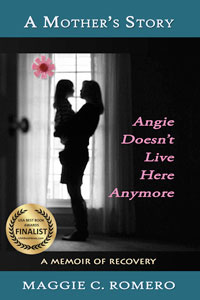
A Memoir of Recovery

“Where might my daughter be now if fate, or genes, had been kinder to her? Now, several years into her illness, I am coming to terms with the terrible legacy that began generations ago in my own family and which I have unwittingly passed on to my daughter.  All these years I’ve diligently searched for answers, clarity, and solace in the face of terrible pain. Like a gift from the universe, it has come to me slowly, and it is with me now. But it’s been a hard won victory.

I liken the effect addiction has on families to a bomb exploding in the living room with everyone nearby.  The shrapnel hits us all in different places; none of us is left untouched, though some may be wounded more than others. Some even ignore the explosion or block it out as the insidious effects of addiction take root in these bewildered individuals.

What happens when a bomb drops anywhere? Doesn’t everybody run for cover? That’s what happened in my family. Angie’s brother and sister got out of the way as much as possible—a healthy response, I suppose—shrapnel wounds can be pretty dreadful. It broke my heart to see them pull away from their sister. But now Angie was so isolated in her family. And so began the long journey, Angie’s father’s and mine, of carrying her, much of the time, on our backs.” ~excerpt from my award-winning memoir, A Mother’s Story: Angie Doesn’t Live Here Anymore, by Maggie C. Romero, available on Amazon


I got an email from my old friend in Virginia whose son is a heroin addict. His sisters have nothing to do with him anymore. It breaks my heart to see the same thing happening in her family, and yet it’s very common. Families are swallowed whole into the belly of the Beast, spit out pieces at a time. Everyone is affected, and though people may try to deny the existence of a problem, or try running and hiding, there is no way to escape the effects of addiction.

Al-Anon and Naranon provide education, compassion, and tools to learn to live with this growing epidemic. We are not alone; we are no longer isolated. Addiction is everywhere. No more shame. No more silence.

Disease Or Choice?

I received these emails over a year ago:

“I am sick of hearing addiction is a disease! It is a choice! I have been clean/sober for over 20 years. I made a choice! I chose to put a needle in my arm. I chose to get drunk because I could not handle what life gave me. Then I chose to get clean and stay clean. Life is all about choices.”

And another: “Addiction is a disease. Recovery is a choice.”

I’ve entered into this debate many times, and I use this situation as an illustration:

A bunch of kids are at a party and heroin is offered. One kid experiments with it and can’t let it go. He gets hooked, looks around to get it, keeps taking it for the feeling it produces. He becomes addicted to it.

Another kid at the same party does the same thing, even likes how he feels when he takes it, but is able to heed the warnings he hears and makes a choice to walk away from it, never tries it again.

The first kid may have the addiction gene in him already and taking heroin just activated it. He didn’t choose to be an addict. He just was. But he still has a choice about recovering from his addiction.

The second kid doesn’t have the inclination toward addiction. That’s why it was easy to say no to it and walk away from heroin.

Both of these women who emailed me are right. I just think we all get bogged down in semantics.


On a more personal level, I see the difference in my own family. Both of my daughters have experimented with drugs. Sadly, Angie is an addict (passed down through four generations in my family).  Except for brief periods when she was in rehab, she hasn’t been able to walk away. My other daughter is not an addict and she doesn’t want to waste her life the way her sister has (Angie’s “choice”). I’m sad to be losing Angie to this terrible disease, but I’m thankful that my other daughter has been able to “choose” more wisely.


Another Perspective

“A Open Letter to My Family (from the drug addict)

I am a drug user. I need help.

Don’t solve my problems for me. This only makes me lose respect for you.

Don’t lecture, moralize, scold, blame, or argue, whether I’m loaded or sober. It may make you feel better, but it will make the situation worse.

Don’t accept my promises. The nature of my illness prevents my keeping them, even though I mean them at the time. Promising is only my way of postponing pain. Don’t keep switching agreements; if an agreement is made, stick to it.

Don’t lose your temper with me. It will destroy you and any possibility of helping me.

Don’t allow your anxiety for me to make you do what I should do for myself.

Don’t cover up or spare me the consequences of my using. It may reduce the crisis, but it will make my illness worse.

Above all, don’t run away from reality as I do.Drug dependence, my illness, gets worse as my using continues. Start now to learn, to understand, to plan for recovery. Find NAR-ANON, whose groups exist to help the families of drug abusers.

I need help: from a doctor, a psychologist, a counselor, from an addict who found recovery in NA, and from God.

Your User”


Enmeshment can be crippling: we don’t have enough emotional distance, often, to deal intelligently and effectively with the addict. Stepping back, detaching, takes discipline and restraint. Such a hard thing to do when we’re in this emotional minefield. It has taken me years in my recovery program to act more and react less. As I said in my last post, I need to deal from strength to be any help to my daughter. The oxygen mask goes on me first.

“Deal From Strength”


“Nar-Anon Do’s and Don’ts:

Do note the effect the user has on each member of the family…

Do always encourage attempts to seek help.

Do remember to see the good in others and yourself.

Don’t accept guilt for another person’s acts.

Don’t nag, argue, lecture or recall past mistakes.

Don’t overprotect, cover up or rescue from the consequences.

Don’t neglect yourself or be a doormat.

Don’t forget that addiction is a disease, not a moral issue..

Do allow other people to accept their own responsibilities.

Don’t manipulate or make idle threats.

Do involve yourself with the activities of Nar-Anon.

Do learn to be open and honest.

Don’t yearn for perfection in yourself or others.

Do grow day by day, by reading Nar-Anon literature.

Do remember to focus on your OWN reactions and attitudes.

Don’t overlook the growth opportunities of a crisis.

Don’t underestimate the importance of release with love (commonly called detachment with love).

Do please try to manage your anxieties with love.

Don’t start the recovery program with the user. Start with the family at Nar-Anon, meeting and learning the difference between destructive and constructive help.”