Humanity Is Changing The Face Of Addiction

A friend in Naranon shared this link with our group recently. I watched it and was so heartened to see how attitudes are changing across the country. This PBS special focused on a program in Seattle, WA. It is a practical and above all humane way to deal with addicts. The more we talk about alternative ways to treat addiction, the more likely there will be people to bring pressure to bear on government officials and on insurance companies. And the more likely our addicts will feel embraced with compassion and understanding instead of fear and judgment.

Chasing Heroin


It’s A Family Illness

Memoir Excerpt: 

“I was starting to feel desperate and wanting to bring my other daughter into the loop again. The holidays were looming and they’ve always been an emotional time for me. I’m flooded with memories, both happy and sad. But more than anything, I remember the anxiety, the frantic covering up, the alcohol-enabled keeping up the appearance of being happy that I felt in my childhood.

As I felt Angie slipping away again, I wrote to Caroline and said I’d hoped she was OK and not getting sucked into Angie’s drama too much. But I needn’t have worried. She and her brother have been able to detach pretty well all these years. Or have they? They haven’t talked to me about what they were feeling, and I haven’t asked. But sometimes I think the bomb that exploded back in 2001 is still exploding, here and there. We’re all still licking our wounds, carrying on.” 

Wake Up America!

From “Thirty-One Days in Nar-Anon,” Day 29:

“Through the sharing of other members and the warmth of their friendship, I started to develop a new strength. I recognized my powerlessness, accepted drug addiction as a disease and avoided having expectations. My frustrations began to vanish. With all the knowledge I acquired through the Nar-Anon program, literature and phone support, I became more open-minded. This brought me a sense of serenity and helped me set more realistic goals for myself.”

Would we even be having this conversation if our children were suffering from diabetes? Of course not!

Addiction is a gravely misunderstood disease, shrouded in secrecy, shame and stigma. Bikies, tatooes, and skid row…oh how times have changed! But thanks to the many programs out there that are educating the public about the true nature of addiction—that it’s a brain disease—awareness is increasing and attitudes are slowly changing.

Look how in one generation the American perception of alcoholism has evolved. We had a recovered alcoholic in the White House for eight years, a man who freely admitted that he struggled with alcohol when he was younger. Alcoholism is also a form of addiction, remember, and it’s my fervent hope that Americans will start to view drug addicts with the same compassion offered to many alcoholics. When public perceptions change, so will attitudes toward our addicted children.

My daughter, Angie, is a heroin addict. If she felt less shame, would she be less isolated? I believe so. In a few other countries, and even in Seattle, WA, there are programs in place to help addicts manage their addiction. This support is specifically designed to keep the crime rate down and help addicts be more functional in their daily lives. In my memoir, I wrote about how Gabor Mate, a doctor in Vancouver, has been an advocate for addicts for many years. He has made a big difference in that city.

How I wish things were easier for Angie, that she be viewed with compassion and not judgment. But I do believe that because of our efforts to raise awareness and set up support programs, life will be easier for future generations. I take a lot of personal comfort in that.
“When I Got Busy, I Got Better”

The Forum

From “The Forum,” August 2015, p. 15:

“Going to meetings helped me understand the first step, which I consider the cornerstone of the program. I cannot repay Al-Anon enough for what it has done for me. One thing I did from the very beginning was to serve the fellowship. Service strengthened my recovery and gave me a chance to pay forward what I’ve received.

My loved one has been in and out of sobriety for the more than 25 years since I joined the program, and whether my loved one was sober or not, I never gave up, slackened my attendance, or service to Al-Anon. Today I can accept that my life is important and that I have a choice to continue obsessing or get on with my life. I accept that alcoholism is a disease and Al-Anon helps me to face the disease and not let it get me down. I feel alive because of Al-Anon. Working the Twelve Steps led me to a spiritual life that gives me much peace and joy.”

Lifelines are all around to help us cope with life’s challenges. Exercise, good nutrition, gardening—the list is endless. Fortunately there are many outlets to choose from, and I’ve used all of the above. But the tools—life lessons—that I’ve learned in several 12-Step fellowships have changed me as well as the way that I relate to other people. I’ve heard it said that alcoholism is a disease of relationships, and whether that’s true or not I can certainly see the improvement in how I behave with others. That, in turn, has made me a happier person. So this has been my lifeline, because working the program has made such a big difference in my life.

One Recovery Tool

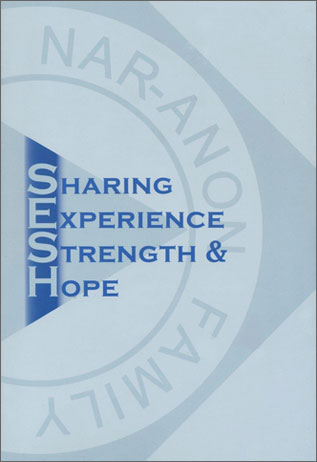
Naranon’s daily reader:

SharingExperienceStrengthandHope

There is a lot of great literature in the 12-Step programs, and this is one of my favorite books. Its focus is on the family and friends of addicts, and it passes on many of the tools of the program to manage and cope with loving an addict. It’s a very slippery slope we’re on, trying to remain loving and supportive without being destroyed by manipulation, abuse and, often, guilt. Page after page in this resource I feel as if I’m reading my own story, reminding me once again that I am not alone in this battle, that there are millions of warrior mothers like me out there. There is strength in our growing numbers, putting an end to our feelings of isolation and giving us hope for the recovery movement.

Who Am I?

Memoir Excerpt:

“I have faltered many times in my recovery. But learning to focus less on my desired outcomes and more on the journey has enabled me to learn more things along the way. I’m learning to slow down and enjoy the ride. And most importantly, it has kept me out of the driver’s seat and open to receiving life’s valuable lessons.”


“Ever since I was a very young child I’d been fragile, like thin ice on a lake—don’t walk on it; you might fall through and drown. My sense of being OK was always shaky when I was younger. Many of us who grow up with low self-worth become chameleons. Chameleons change their color out of fear to protect themselves from predators. We don’t have clear personal boundaries, often not recognizing where we end and others begin. We don’t really know who we are, so we attach ourselves to whomever we’re around, often seeking their approval by pretending to be like them. But like the chameleon who turns green in the jungle, we are afraid to distinguish ourselves. I remember telling Angie back in 2010, ‘I know who I am now.’ Well, that’s an ongoing process.”

Collateral Damage

Memoir Excerpt:

“I was starting to feel desperate and wanting to bring my other daughter into the loop again. The holidays were looming and they’ve always been an emotional time for me. I’m flooded with memories, both happy and sad. But more than anything, I remember the anxiety, the frantic covering up, the alcohol-enabled keeping up the appearance of being happy that I felt in my childhood.

As I felt Angie slipping away again, I wrote to Caroline and said I’d hoped she was OK and not getting sucked into Angie’s drama too much. But I needn’t have worried. She and her brother have been able to detach pretty well all these years. Or have they? They haven’t talked to me about what they were feeling, and I haven’t asked. But sometimes I think the bomb that exploded back in 2001 is still exploding, here and there. We’re all still licking our wounds, carrying on.”

The Pain of Resistance

outsider red egg

From In All Our Affairs: Making Crises Work for You

“I had always wanted to be different, better than others. It comforted me to believe that I loved more, cared more and suffered more from the effects of someone else’s drinking.

I was different when I went to Al-Anon. I suffered from these feelings of alienation, yet while I wanted to belong, I wanted even more to remain apart—to hang on to my old life, my old thinking. I felt that as I accepted each truth, each part of the program, some portion of me was going to die. I was not capable of believing that there would be a new life, or that a mature woman might be born from the wreckage of a guilt-ridden, obsessive child.”

My resistance remained even as I took the Steps of recovery. While I made progress emotionally through friendship and the release of some of my anxiety, I was unable to surrender myself to the idea of a Higher Power. It was a few years before I made that final surrender. Then and only then did I have any idea what Al-Anon was all about. I now understand my uniqueness. There is no one else on earth exactly like me, but with God as my partner and as a member of such a fellowship, I am not alone.

Isolation and Addiction

Memoir Excerpt:

“I felt very isolated much of the time. And one day, I think I was eleven, I sat on the family room step facing the driveway, took a piece of glass I’d found, and cut my wrist. I still have the scar. But either I wasn’t seriously suicidal or I was pretty dumb about anatomy because the cut was on the far side of my wrist, as far away from the vein as you can get.

Mother was alarmed at the sight of my bleeding wrist and asked me how it happened. Well, that’s one way to get you out of your bedroom, I thought to myself. I lied to my mother and told her I fell on a piece of glass in the driveway. She believed me and the incident was forgotten. In fairness to my family members, my parents in particular, I had become very adept at covering up my pain. They were distracted with plenty of their own, so I just went underground with it. Was this a cry for help? Of course! It was one of several in the next few years that would be ignored or loudly sighed about. My cries provoked much anger and frustration. I was definitely “the problem child” in my family, which kept everyone from confronting, a few years later, the alcoholic right under their nose.

Daddy’s alcoholism got worse and became more apparent as he got older. The elephant was in the living room, clear as a strident cowbell. But there was no serious intervention. This was the early Sixties, when alcoholism wasn’t so openly talked about, at least not in our family. So everyone turned their attention to the baby of the family. I had acted out, first as a child against my sister and then in other ways as I got older. I would rebel a lot in subsequent years and give my family plenty to focus on. I felt like the family scapegoat. And the weight of it, through most of my childhood and young adulthood, was very hard to carry.”

http://www.amazon.com/gp/product/1940769140/ref=as_li_tl?ie=UTF8&camp=1789&creative=390957&creativeASIN=1940769140&linkCode=as2&tag=merchear-20