“Changed Attitudes Can Aid Recovery”

From Each Day A New Beginning, June 29:

“Self-pity is a parasite that feeds on itself. Many of us are inclined toward self-pity, not allowing for the balance of life’s natural tragedies. We will face good and bad times—and they will pass. With certainty they will pass…

Recovery is learning new responses, feeling and behaving in healthier ways. We need not get caught by self-pity. We can always feel it coming on. And we can let it go.”

In my recovery program, I’ve leaned that I have choices. I don’t have to be on automatic pilot anymore. “Awareness, acceptance, action”—the 3 A’s. I can choose new attitudes. I can choose acceptance and gratitude. Then happiness will follow me.

Who Are Our Teachers?

Memoir Excerpt:

My unsent letter to my child:

‘Dear Angie,

Ironic, isn’t it, that you have become my teacher and not the other way around—teacher of life, teacher of love, and beacon of surrender.

I’m so grateful that you were born, even though at times I’ve felt otherwise. God works in mysterious ways, doesn’t he? Though you haven’t been in my life long, and not always happily, it’s been your very existence that has propelled me into a serenely spiritual life, even happiness. I never would have done the work necessary to reach this place without your inspiration.

You are my child, my teacher. As I’ve stumbled on this rocky path, my thoughts of you have guided me; they guide me still.

All that I’ve become are gifts from you, my daughter: life lessons, trial by fire. How do I thank you?

By living well—By loving well—Mom’

‘God grant me the serenity to accept the things I cannot change.’ I cannot change the fact that Angie is an addict, and I cannot ‘wish’ her into recovery. I can only love her. And—this catch-22 has taken me most of my life to learn—I can only love her or anyone else in my life with any integrity, if I love and value and respect and cherish myself first.”

Accepting Addiction As A Disease

“Learning that addiction is a disease offers us a new understanding and suggests that compassion could replace anger and hurt. We can spend our time wishing things were different but must accept the fact that we have no power over another human being. We need to care enough about ourselves to give up the struggle over which we have no control. We may have tried many things such as keeping score, pointing the finger and blaming others in order to keep from feeling so much pain. No matter how harsh reality is, we can learn to accept each new day with confidence.

Accepting addiction as an illness helps us realize we cannot waste action and energy in fighting the battle but instead we can seek recovery for ourselves.”


Is it a disease or a choice? I’ve entered into this debate many times. But I’ll leave the final word to the experts, one of whom, Nora Volkow, I quoted in my memoir:

“Insist that our loved ones are choosing to be addicts, that they want to stick a needle in their arm and live in a gutter, and we feel justified in our anger and our bitterness. Keep feeding those feelings, and they will consume you. I choose to believe that my daughter is wired differently and is prone to addictive disease. That’s no surprise, since four generations in my family have all had addictive disease in varying degrees. For whatever reason we still are unsure of, whatever life stresses beckoned her into that dark place, she became a victim of addiction.

Dr. Nora Volkow, director of the National Institute on Drug Abuse, has said: “I’ve studied alcohol, cocaine, methamphetamine, heroin, marijuana and more recently obesity. There’s a pattern in compulsion. I’ve never come across a single person that was addicted that wanted to be addicted. Something has happened in their brains that has led to that process.”

Accepting Ourselves

“If we have submerged ourselves in the needs of others we may have lost sight of who we are, our self-esteem and individual rights. Awareness of the futility of doing the same things over and over, trying to control another person, and expecting that one day these actions will work, is freeing if we allow it to be. We are entitled to our own opinions, beliefs, limitations, and strengths. Accepting and loving ourselves for who we are will enable us to grow and change.

The less we try to manage others’ lives, the more effective we become. If we are accepting of others and the things around us, we can simply be ourselves.”

The definition of insanity: doing the same thing over and over again and expecting different results. I have accepted that my Higher Power will restore me to sanity. I will cease trying to force solutions and control my daughter. She has her own path and her own Higher Power. And I have mine.

Accepting Imperfection

“When we strive for perfection in ourselves and expect it in others, we may feel we have failed when this doesn’t meet our expectations. This step teaches us to accept each other and ourselves as we are, even if it’s less than we had hoped. We strive only to do our best. This invites us to practice humility in order to begin our progress toward recovery.”


True humility is the ability to see myself in relation to God, and this keeps me where I need to be with the people in my life. It has nothing to do with humiliation; it’s maintaining a realistic and balanced perspective of myself. I’ve heard it said that addiction is a disease of relationships, and it certainly has the power to destroy them. When I try to let go of many of my defects and practice humility, my relationships work better. This, I believe, is God working through me.

“Living Well Is The Best Revenge”

I’ve received many emails from moms asking me how I cope with the living death of Angie’s heroin addiction. She’s neither dead nor alive. Many of my friends here know the hellish limbo I’m living in, without any resolution or closure. But I have found a way to cope well and move on with my life. This is what I wrote back:

“I put my grief in a back drawer and close it. Then I look at what’s in my front drawers every morning. I have so many wonderful things to be grateful for. Instead of focusing on the problem, I try to keep my mind on the solution. This is how I live. It keeps me humble, grateful, and glad to be alive. I honor Angie’s memory in this way, and I truly believe she would want me to live well and be happy. Blessings to you, Mom.”


Who’s In Charge Here?

The Serenity Prayer (Part 2):

“to accept the things I cannot change…

One accepts when one receives. To understand, to take into the mind without debate as one receives a gift – this is acceptance. Serenity precedes acceptance. It must. There is order to this. My mind must be calm in order to understand what you are saying. To listen to you without debate, I must not be afraid of you. With the gift of Serenity, I am able to accept people and circumstances as they are, not as I want them to be or as I think they should be. I am willing to accept the bad as well as the good, because it is all part of the plan. When I accept a situation as it is, when I accept you as you are, I have stopped playing God.”

My work in the program has humbled me as I’ve learned to view myself in relation to God. For reasons that don’t matter now, I always felt that I had to be in charge of my life and those closest to me. But when Addiction hijacked my daughter, I was not only blindsided but powerless as well. It took me a long time to accept that Angie was in the grips of something far greater than either one of us. This acceptance enabled me to let go of my illusion of control and turn to my Higher Power for help. My faith continues to get me through the darkest days because I’m not in charge—He is.

Letting Go…Over And Over Again

From The Forum, June, 2015:

“My son’s future is his—not mine. ‘He is not living his life for me,’ I thought as I shuffled into the cold kitchen. It was three o’clock in the morning. I was in search of an Al-Anon daily reader. My son, my only child and someone I loved more than anyone, had been arrested, spent the night in jail, and was in more trouble than I ever imagined possible.

I had never thought that my child, whom I put through college and spent many waking hours imagining his promising future, would be in that situation. However, all of that changed when his addiction became known to the family. From that time on, I faithfully attended Al-Anon meetings, sometimes four times a week, got a Sponsor, chaired and spoke at meetings, and volunteered to speak at an Al-Anon meeting at the women’s prison.

My son’s future was my future, and I told myself that my efforts made in recovery were for the both of us. Deep down, however, I was betting that my recovery would ultimately guarantee his recovery. In my heart, I believed that the love we shared along with the Al-Anon and A.A. program would be the life raft he needed to recover. I was his mother. I could make it happen…

Now, weeks after the arrest, awake at 3 a.m., I reached for the book, Courage to Change, and randomly opened to a page that said, ‘You can’t live someone’s life for them.’ It was what I needed to hear. As challenging as it was, I had to stop living his life and focus on myself. I had to let go of the life he was creating and embrace my own life…

Finally, I was beginning to understand that for my serenity, I had to live each day focused on myself and my recovery.”


In my memoir, I said the same thing, a reflection of my early time in recovery. Drowning in codependence, I hadn’t yet accepted that Angie’s illness was something I wasn’t responsible for nor was it something I could control with my own recovery:

“In fact, I was still so joined at the hip with her that, in the beginning during the brief periods when she was in recovery, I used to claim at meetings that our mutual recoveries were intertwined. I remember saying, ‘I have no doubt that her recovery goes along with my recovery.’ My Program friends just nodded their heads in support, probably wondering what the heck I was talking about. It would take a number of years and much Twelve-Step work to rid me of that notion.”


Of course it gives us parents much comfort to think that we have the ability to save our children. We all wish we had that power. But that power ultimately rests with the addicts themselves. We can offer love and emotional support. But because of the complexities of the disease, we need to let go and allow the addict to take responsibility for his own recovery.
Inner Peace

The Serenity Prayer (Part 1):

“God grant me the serenity…

I have known peace. The peace that comes in front of a fireplace on a cozy winter’s night, the peace of the mountains. But when I would leave the mountains, the peace would leave me. When the fire went out or the phone rang, the peace would be gone. Peace came rarely and went quickly – a mood conjured by myself for myself. Serenity is different. It is with me and in me. Nothing disturbs it. It is not given; therefore, it cannot be taken away.”


When I work at my recovery program using the tools at my disposal, I am free of the burden that brought me into the rooms. The first three steps—admitting my powerlessness over addiction, believing that a Higher Power could restore my sanity, and turning my burden over to Him—have taken the weight of the world off my shoulders. Serenity is mine to take when I let go and have faith in God’s plan. This doesn’t rid us of our problems; it just makes them easier to bear.

Find Something To Smile About


look for the good 1

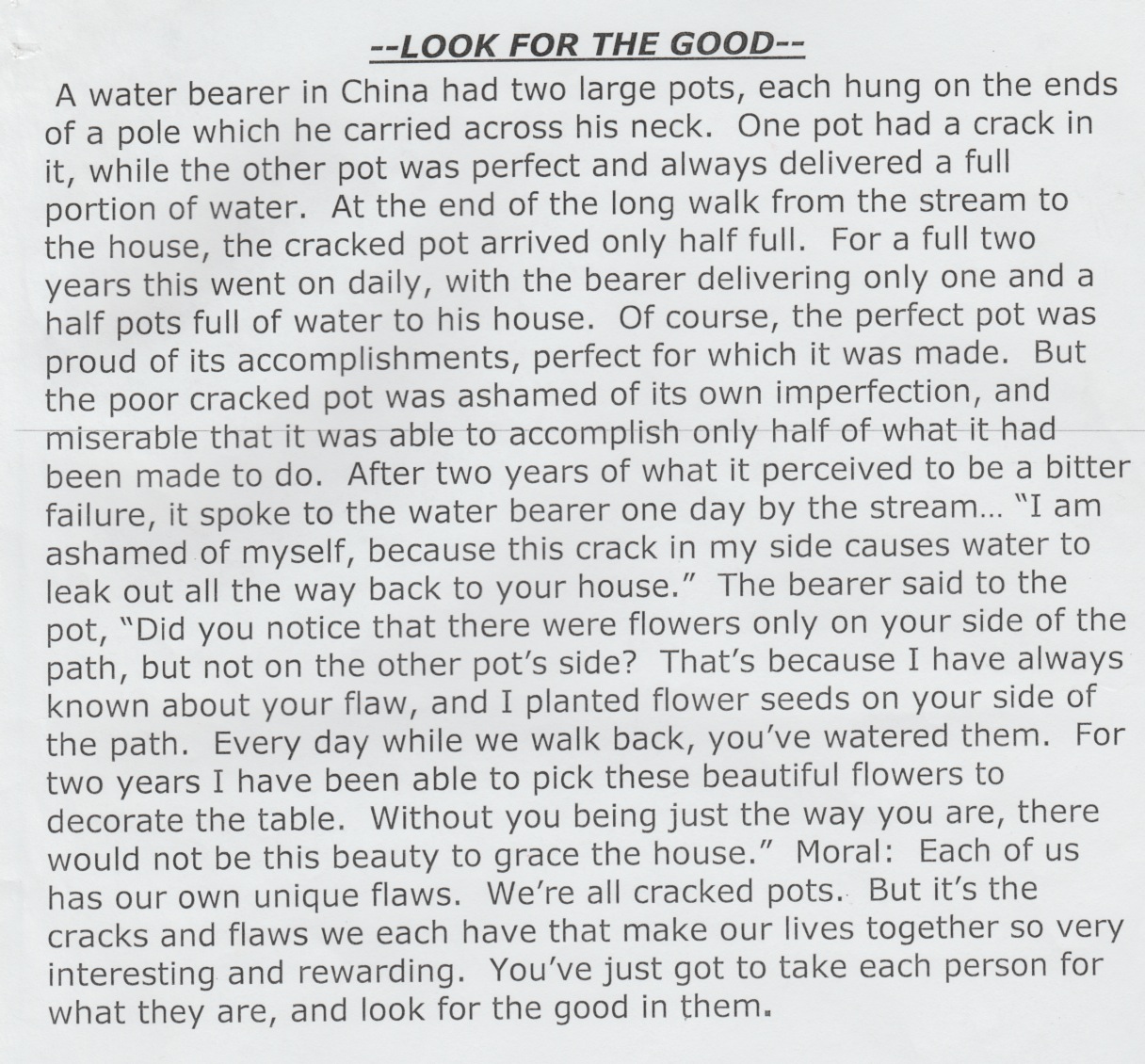
Silver linings are everywhere in our lives. I try to appreciate them when I see them. My family has lived through four generations of alcoholism, but it wasn’t until my daughter was stricken with drug addiction that I was motivated to go into serious recovery for myself. Losing Angie all these years to this cruel disease has been heartbreaking, and my serenity has come at a very high price. But though I’ll never get over these lost years with her, I like to think that she would be glad that I’ve survived and am learning to live well. This is how I honor her memory. She’s left a few flowers along the way, and I’m grateful.