Two steps forward, one step back. Two steps back, one step forward.
“Progress, not perfection.”
It’s the striving—the journey—that matters. And though we get tired from all the struggle, it’s that very work that builds up our resistance to life’s challenges. Substance use disorder, whether it’s in us or a loved one, is a huge test of our mettle. And like many difficult things, we don’t always get it the first time.
I didn’t. With my daughter, I kept thinking that I needed to be in control because she wasn’t making good decisions. But what I’ve learned on my recovery journey is that I don’t have control over another adult’s life, and least of all while they are under the influence of drugs. As painful as that reality is, I do accept it now.
Do I waver? Am I human? Am I tempted to keep trying something else? Of course!
That’s why I keep coming back—to listen and learn.
“First become a blessing to yourself so that you may be a blessing to others.” ~Rabbi Samson R. Hirsch
What a Sisyphean task that has been for me. In order to become “a blessing to myself,” I had a lot of work to do. I needed to clear away the debris from my past, clean up my side of the street, make amends to anyone (including myself) necessary, and move forward.
These words, all in a sentence or two, represent a lifetime of attempts at self-improvement, reaching for happiness. And just good clean living. It’s a daunting amount of work. Change is difficult for anyone. But I was determined, when I hit my bottom, to try to be a better version of myself.
It’s been my sincere love of all those around me—both friends and family—that catapulted me into what I hope will be a lasting state of recovery and the peace that goes with it.
And timing is everything in life. I’m ready to adopt an attitude of gratitude and enjoy the years in front of me. Life is good.
When I joined Al-Anon, I was in my Fifties and determined to help my daughter let go of her substance abuse disorder. But, oh, what a relief it’s been to let go of that obsession, which was becoming so shrill and counterproductive.
I was glad to turn the focus back on myself and learn that my faulty attitudes were the source of my pain, not the people around me.
Regarding the amends steps, it’s possible to overuse them, just as we might exaggerate our negative defects in the 4th step. I’ve done both! That’s why it’s so important to understand the purpose of amends: reaching personal freedom.
These are intended to be hopeful steps, not self-flagellation. Making this list and then acting on it is just another way to weed our garden. My partner is always reminding me to weed close to what we’re growing, so that nothing interferes with the growth of the plant.
Making amends is not always pretty, and rather than freedom I sometimes look for forgiveness and closure. With my daughter, Annie, she threw them right back in my face. But my sponsor helped me appreciate my efforts and then let them go.
My real reward has been surviving that loss without the need to punish myself for it. Truth is, I’m really not that important! Things happen in life, and it’s not always my fault.
Before I went into recovery, I was pretty lost. On the outside, my life seemed to be rolling along well. But on the inside, I was insecure and sad. I dealt with these feelings in unhealthy ways, but didn’t feel much pressure to change them. I never missed a day of work, and I appeared to be fine. But appearances can be deceiving. Nothing had yet occurred to call my choices into question. Nothing had happened yet to push me out of my complacency.
But when my middle child fell victim to substance use disorder, after I had tried and failed over and over again to help her, I broke. The carefully manicured life I had been living was a treasured glass from my cupboard, smashed onto the kitchen floor. Many little shards, and some big ones. I cut my fingers cleaning it up.
My recovery fellowship comes with a philosophy that teaches me many different things. And one of those things is to forgive myself and others for the transgressions we inevitably commit in our lives. Our common humanity dovetails at every meeting I go to, where we encourage ourselves to face our defects, let them go, and move on.
For years, I held on to mine to punish myself for my part in Annie’s disease, and most importantly, for failing to “save” her. I have learned, gratefully, that my daughter suffers from substance use disorder, as do I, and I could no more save her from it than if she’d had diabetes. I simply don’t have that power.
So I try to stay away from martyrdom and self-pity, because neither of those feelings will help Annie get well, and they hurt me a great deal. That’s where the weeds are. They muddy the waters; they keep me angry and sad. When I steer clear of them, it takes some of the sting out of losing my daughter. I can more easily open my heart to what remains in my life.
The miracle of my recovery is that, like a gentle breeze blowing away the clutter of remorse, my eyes can see my life through another lens now, one full of gratitude, humor and love. The fruits of my recovery rest on these three things.
“We forget that the depths teach us how to better appreciate the heights.”
From Each Day A New Beginning, Karen Casey, CAL, August 20:
“’Everything in life that we really accept undergoes change. So suffering must become love. That is the mystery.’ ~Katherine Mansfield
Acceptance of those conditions that at times plague us changes not only the conditions but, in the process, ourselves. Perhaps this latter change is the more crucial. As each changes…life’s struggles ease. When we accept all the circumstances that we can’t control, we are more peaceful. Smiles more easily fill us up. It’s almost as though life’s eternal lesson is acceptance, and with it comes life’s eternal blessings.”
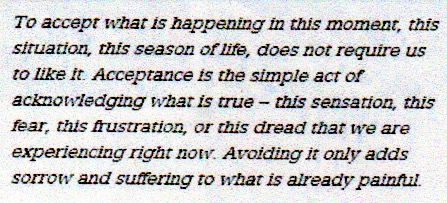
This is a hard one for me. Hard because, like many people, it is hard to accept the pain of loss. Like a recent amputee, I miss what’s not there. I miss my childhood; I miss my daughter; I miss some friends who have passed.
And at times I resist. I go into fighting mode where I refuse to accept. But that place is not peaceful for me. It stirs up feelings, long set aside as harmful: guilt, longing, even at times the wish to punish myself.
Whoa! This is why I need my recovery program, to keep me, first of all, on the road and secondly, charting a healthy course. It will do me no good to dwell on the pain of my losses. But it will help me grow a great deal if I can accept them with grace and try to let go of the pain. It will lead me to love.
There are joys in my life that clamor for my attention. That I still have the heart to embrace them openly, not as a consolation, but as emerging gifts worthy of my full attention, is how my grief leads me to a place of love.
Acceptance is the answer for me. It prevents me from getting stuck, and gives me the freedom to move forward.
“…I feel comfortable participating in…meetings because in them I find an atmosphere of trust and mutual respect. However, I wasn’t always so open. There have been times in my life when I didn’t trust and I didn’t receive respect, so I withdrew. I didn’t allow myself to stay and work through the challenges offered to me. Now that I’m in recovery, I don’t want to limit my opportunities to grow by restricting my involvement with others, whether or not they are in the program. As always, (my program) teaches me to pray, look at myself and my attitudes, and then take action. For me, this action means detaching from people’s behavior and giving them the same acceptance, consideration, and respect for which I long…When I don’t expect perfection from others or from myself, I am free to participate and be a part of life.”
This quote really resonates with me. As I said in my new book: “Humility, I discovered, is a tremendous leveler, and it would bring me closer to what I’ve been missing my whole life: being part of a community of equals.” I’m so happy to be in a fellowship where we’re all on a level playing field. We try not to compare, just to support.
I’ve heard it said that “expectations are premeditated resentments.” So I try to keep my expectations of others in check, aware of my tendency to control and manipulate. It takes a lot of discipline to remain detached, especially from a loved one. But I can’t control the behavior of (my adult daughter), and so I’ve learned to let go and keep the focus on myself and consider how I might be the author of my own discomfort. When I offer “acceptance, consideration, and respect to others,” the same gifts return to me ten-fold.
Most of us have experienced the pain of substance use disorder, either directly or indirectly. It’s everywhere in our society, and addiction in all its forms has the power to take away our happiness and wellbeing. My daughter Annie has scrambled in and out of the rabbit hole for over nineteen years, and much of the time I was in it with her. But I’ve learned to let go of a disease and its ensuing consequences that I have no control over. Yes, let go.
Once the tears dried and I could open my eyes, I looked around to see what was left from all the chaos and devastation: a job I liked, flowers blooming, other family members, good health, enough money to be comfortable, friends who cared and didn’t judge me. The list went on. These little girls are my great joy, and if I didn’t have them I hope I could try to celebrate something else—anything else—in my life, even though some days the grief is overwhelming. Time passes too quickly, and before I know it, mine is up. Life is too precious to waste.
My years in the recovery rooms have taught me grace, and the courage to embrace all of my life—the good, the bad, and the ugly—as an expression of God’s will for me. I’m blessed to be part of a spiritual program that teaches me that painful lesson, despite my loss—or maybe, when I look at this picture, because of it.
From Each Day A New Beginning, Conference Approved Literature, January 9:
“’The Chinese say that water is the most powerful element, because it is perfectly nonresistant. It can wear away a rock and sweep all before it. ‘ ~Florence Scovel Shinn
Nonresistance, ironically, may be a posture we struggle with. Nonresistance means surrendering the ego absolutely. For many of us the ego, particularly disguised as false pride, spurred us on to struggle after struggle.”
Well, I don’t do anything absolutely, but my time in recovery has strongly encouraged me to remain right-sized in my thinking. EGO—Easing God Out—is a useful reminder that I don’t always know what’s best in any situation. But my resistance often keeps me stuck.
Whether it’s wondering how to cope with my addicted daughter, Annie, or wondering how to face the loneliness of Covid isolation, or determining what to do about a barking dog in the wee hours of the morning, all of these problems require some level-headed judgment, which I don’t always have.
So I find the power of prayer to be a wonderful relief and solution to my thinking that I have to fix every problem.
If it’s a situation I can control, I’ll try to do something.
If it’s not something I have the ability to control, I’ll try to let it go.
And determining which is which, needless to say, is our biggest challenge.
From Each Day a New Beginning, Conference Approved Literature, May 22:
“’The change of one simple behavior can change other behaviors and thus change many things.’ ~Jean Baer
Our behavior tells others, and ourselves, who we are. Frequently, we find ourselves behaving in ways that keep us stuck. Or we may feel deep shame for our behavior in a certain instance. Our behavior will never totally please us. But deciding we want to change some behavior and using the program to help us, is a first step.”
Change is hard. The older we get, perhaps, the harder it gets. Our years—our habits—can trap us. I’ve been trapped by my own worst defects: “I’m gonna be fine;” “I can handle it on my own;” “I don’t need any help, thank you very much.”
Trying to figure out the why’s of things over the years didn’t help me. That question just kept me stuck. And it kept me from taking responsibility for my own problems. So the suffering continued. Until I learned how to put out fires.
When I’m in the middle of a fire in the woods, I don’t wonder who started it. If I am to survive, I just need to learn how to douse it.
I’ve been challenged by depression for much of my life, but nothing could have prepared me for losing my daughter Annie to the living death of heroin addiction. That was the major conflagration in my life, and I wasn’t fighting it effectively. I made it so much about me and my misplaced guilt that I often used poor judgment in an effort to help her. When I saw that nothing was working, I felt broken. And at my bottom, that’s when I found the courage to change.
Letting go of my feverish attempts to motivate Annie to seek recovery, and my wish to control events, freed me of the painful circumstances that were claiming my peace of mind. Letting go—so counterintuitive when it’s your child—was one of the first steps I needed to take—and accept what I could not change. That was the hardest: knowing that I had no power to change her. But I did and do have the power to change myself, my reactions, and my attitudes.
At some point along the way, we might find ourselves in a fire we need to put out. I learned that I needed to change before I could be truly happy with my life. I needed to pay attention to what was happening in my own hula hoop. Looking outside of myself for answers only distracted me; it did not help me put out the fire.
“One small change today, a smile at the first person I meet, will help me chart a new course.”
From Courage to Change, Al-Anon conferenced approved literature, May 30:
“As a result of living in a household where alcohol was abused, the concept of being gentle with myself was foreign. What was familiar was striving for perfection and hating myself whenever I fell short of my goals…If I am being hard on myself, I can stop and remember that I deserve gentleness and understanding from myself. Being human is not a character defect!
‘The question is not what a man can scorn, or disparage, or find fault with, but what he can love, and value, and appreciate.’ ~John Ruskin”
We pass on what was given to us. And so the three A’s—awareness, acceptance, and action—have helped me see clearly what I’ve needed to change about myself and, by extension, others.
As I have learned in recovery to love myself more and to treat myself with kindness, I have passed that on to family and friends all around me.
So often as adults we appear to be on automatic pilot, behaving in ways that make us cringe afterwards. Our caretakers were often our role models, and we learned how to parent from them. No one’s life is perfect, and few people have perfect parents. But however we fared growing up, the beauty of recovery is that we get to do things over—with more gentleness and compassion for ourselves as well as our caretakers. Especially those we learned from. We can do things differently now if we want to. These are “living amends.”
“We have two lives… the life we learn with and the life we live with after that.” ~Bernard Malamud