
I’m Glad I Stayed

From “The Forum,” March 2017:

“’I came for a quick fix and found a way of life.’ ~Bertie P., Florida

As I look back, when I walked through the doors of Al-Anon, I had planned to stay long enough to find out how to get the miracle of sobriety in my home. I’m still there!

I was broken spiritually, emotionally, and physically. I had given up on everything and everyone. A friend dragged me to Al-Anon, but I was sure it was hopeless.

After my first meeting, I was still very angry. How could all those people be happy and smiling? Their homes could not be as bad as mine. Fortunately, I wanted to laugh and smile too. A member, who later became my sponsor, took an interest in me as a newcomer, and I kept coming back.

The slogans and all the tools annoyed me, and I didn’t share…Did I ever have a closed mind! But…I kept going…

I started taking care of myself and gave the alcoholic a choice to get help or go his own way. Five years later, the real miracle was finding me…I learned how to change my life and really live.”


Wishing/hoping/praying that my daughter Angie will tire of her life and seek recovery is holding myself hostage to something I have no control over. And I don’t want to be a hostage. I want to be free. My recovery program has given me the tools to live my life unencumbered by other people’s choices.

“God, grant me the serenity to accept the things I cannot change, the courage to change the things I can, and the wisdom to know the difference.”
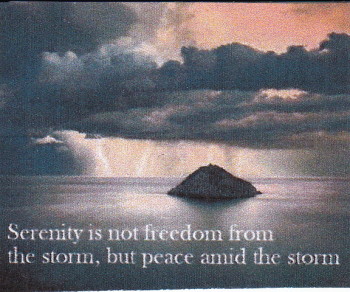


A Quiet Mind

From Courage to Change, September 4:

“As we let go of obsession, worry, and focusing on everyone but ourselves, many of us were bewildered by the increasing calmness of our minds. We knew how to live in a state of crisis, but it often took a bit of adjustment to become comfortable with stillness. The price of serenity was the quieting of the constant mental chatter that had taken up so much time; suddenly we had lots of time on our hands and we wondered how to fill it.”

Over time, I’ve learned how to “be still in the stream.” It took a long time for me to accept my powerlessness. But obsessing over Angie and living in all her drama was threatening my health. I was suffering from severe PTSD and endured many other negative consequences in my life as a result of my constant worry over something I couldn’t control.

So, I took the first three steps in my recovery program. It was hard to do that because I felt that letting go was giving up on my daughter. Not loving her anymore. But that’s not how I feel now.

Once, not so long ago, Angie was a loving daughter to me, a college graduate with her whole life ahead of her. Then, like the great cosmic crapshoot that afflicts millions of families, she fell out of her life and into addiction. She’s been lost to us all for a long time now.

But my daughter Angie, not the addict that lives in her body, would want me to reclaim my life as I have, and learn to be happy.

I believe this with all my heart.

Turning It Over

From Courage to Change, January 23:

“In Step Three, we “made a decision to turn our will and our lives over to the care of God as we understood him.”  This is a big decision for those of us who have a tough time making even small decisions. Until I found Alanon, I tended to let others decide how I should live, where I should go, and what I should do. The paradox is that, though I took little responsibility for my own life, I saw myself as an expert on everyone else’s life and felt accountable for all that happened.

The order in which the first three Steps are written helps me overcome these attitude problems. First, I accept my inability to control the disease of alcoholism and admit that my life is unmanageable (when I try to exert control, my words). Next, I come to believe that a Power greater than myself can help. After taking these two Steps, it becomes possible, desirable, and even logical, to make the enormous decision to trust my life to a Higher Power’s care.”


Many feel that the First Step is the hardest: to admit that we are powerless to help our loved one through addiction. We love, and intuitively, we want to rescue him from the disaster than might be coming. But—and this is a process that takes longer for some than others—once we accept the reality of our powerlessness, and ask for help to let go of our loved one in his addiction, there is a freedom that defies description.

And we can move on with our lives.

Remember life? It’s still out there!

Humanity Is Changing the Face Of Addiction

A while back a friend in Naranon shared this link with our group. I watched it and was so heartened to see how attitudes are changing across the country. This PBS special focused on a program in Seattle, WA. It is a practical and above all humane way to deal with addicts. The more we talk about alternative ways to treat addiction, the more likely there will be people to bring pressure to bear on government officials and on insurance companies. And the more likely our addicts will feel embraced with compassion and understanding instead of fear and judgment.

https://www.pbs.org/wgbh/frontline/film/chasing-heroin/


“Living Well Is The Best Revenge”

I’ve received many emails from moms asking me how I cope with the living death of Angie’s heroin addiction. She’s neither dead nor alive. Many of my friends here know the hellish limbo I’m living in, without any resolution or closure. But I have found a way to cope well and move on with my life. This is what I wrote back:


“I put my grief in a back drawer and close it. Then I look at what’s in my front drawers every morning. I have so many wonderful things to be grateful for. Instead of focusing on the problem, I try to keep my mind on the solution. This is how I live. It keeps me humble, grateful, and glad to be alive. I honor Angie’s memory in this way, and I truly believe she would want me to live well and be happy. Blessings to you, Mom.”


Edging God Out

Ego is the great separator from God.

True humility is the ability to see myself in relation to God, and this keeps me where I need to be with the people in my life. It has nothing to do with humiliation; it’s maintaining a realistic and balanced perspective on myself.

I’ve heard it said that addiction is a disease of relationships, and it certainly has the power to destroy them. When I try to let go of many of my defects and practice humility, my relationships work better. This, I believe, is God working through me.


White Knuckling

From Each Day A New Beginning, August 15:

“’Life does not need to mutilate itself in order to be pure’. ~Simone Weil

How terribly complicated we choose to make life’s many questions. Should we call a friend and apologize or wait for her call? Are the children getting the kind of care they must, right now? That “we came to believe in a power greater than ourselves” is often far from our thoughts when we most need it.

Our need to make all things perfect, to know all the answers, to control everything within our range, creates problems where none really exist. And the more we focus on the problem we’ve created, the bigger it becomes.

The program offers us another way to approach life…We can learn to accept the things we cannot change, and change the things we can—with practice.”


My recovery requires hard work. But the result is beyond what I had ever imagined. White knuckling my way through life only made me miserable. I’m glad I chose to let go of my need to always be in charge and have faith in something greater (and smarter) than me.

I will practice acceptance today. I will loosen my grip on the elements of my life and feel the color coming back to my knuckles. And the world will keep turning.


The Freedom That Comes With Surrender

From Courage to Change, January 14:

“I learned in Alanon that I’m bound to fail to make someone else stop drinking because I am powerless over alcoholism. Others in the fellowship had failed as well, yet they seemed almost happy to admit it. In time, I understood: by letting go of this battle we were sure to lose, we became free.

Gradually, I learned that nothing I did or did not do would convince my loved one to get sober. I understood intellectually, but it took time before I believed it in my heart…Today I will take the path to personal freedom and serenity that begins when I surrender.”


My mother love doesn’t operate on an “intellectual” level. I behave on instinct, and it’s a natural instinct to want to save our children. I tried to save Angie—for years. I thought that NOT trying was giving up. And I would never give up on my child.

In time, I learned about the nature of addiction—what it was and what it wasn’t. It’s not a choice or a moral failure; it’s an illness, and I have no more power to cure her from that than from any other disease.

So, other than leading Angie to programs that might help her, I’ve let go. There’s nothing more I can do. I pray for her and hope she reaches for recovery from the illness that has separated her from her family. And I hope she comes back to us.

But life is short, and I want mine back. I’ve turned my attention to other people and things in my life. I count my blessings every day, and I’m grateful to be alive. There are lessons I’ve learned that only suffering teaches, and I join hands with all loved ones of addicts here. God Bless Us All!