Anyone But Me

From Each Day A New Beginning, February 19:

“’God knows no distance.’ ~Charleszetta Waddles

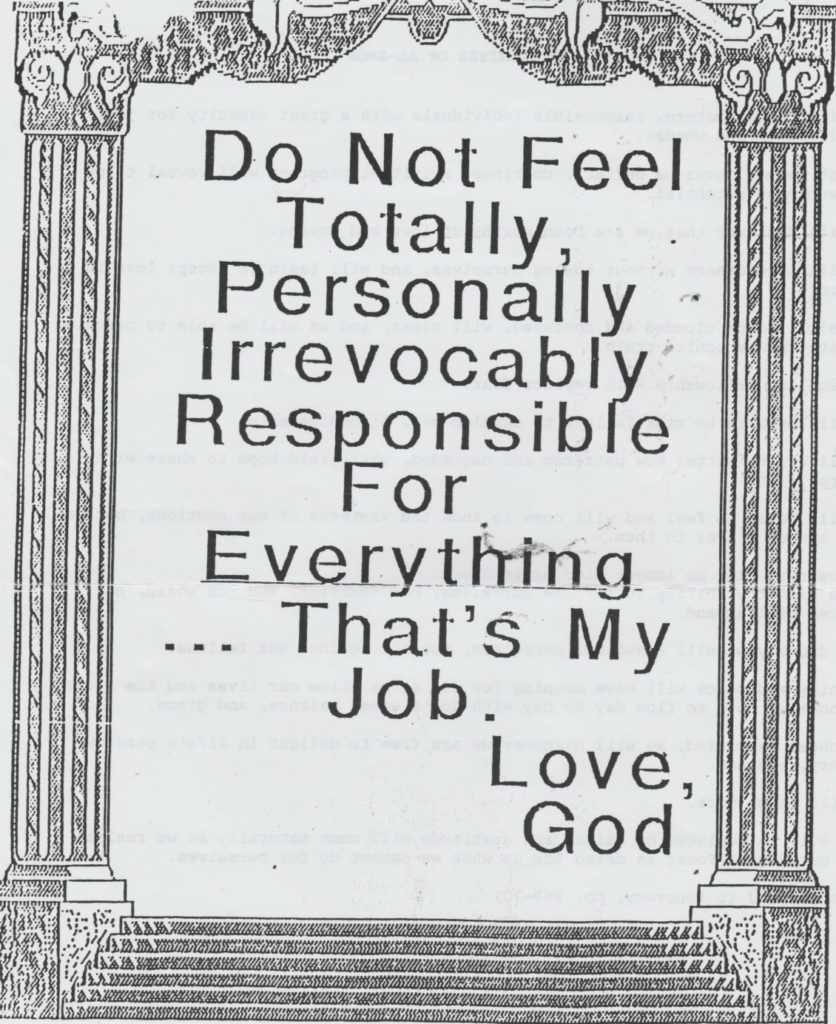
Relying on God, however we understand God’s presence, is foreign to many of us. We were encouraged from early childhood to be self-reliant. Even when we desperately needed another’s help, we feared asking for it. When confidence wavered, as it so often did, we hid the fear—sometimes with alcohol, sometimes with pills, Sometimes we simply hid at home. Our fears never fully abated…Slowly and with practice it will become natural to turn within, to be God-reliant rather than self-reliant

There’s a joke in the Program that “our best thinking got us here (into the rooms of recovery).” And it’s so true! I joke at meetings that I’ve always been “CSR,” compulsively self-reliant.” I have been for much of my life, afraid to ask for help and even more afraid to accept it. As a child I had to rely on myself for so many things, and that became a survival strategy. But as an adult, that very façade of strength can become a terrible defect. Appearing as a formidable wall of arrogance, it only served to isolate me and separate me from my peers. I had to tear down that wall.

And when I did, when I found the courage to bare my fears and vulnerabilities and ask for help when I needed it, I found my humanity. My faith in a power greater than myself enabled me to let go of my self-reliance and join hands with others as we reached out and helped one another.

It hasn’t removed the problems from my life. But it has made facing them so much easier.

Our Footprints

From Each Day A New Beginning, December 20:

“’Somewhere along the line of development we discover what we really are, and then we make our real decision for which we are responsible. Make that decision primarily for yourself because you can never really live anyone else’s life, not even your own child’s. The influence you exert is through your own life and what you become yourself.’ ~Eleanor Roosevelt”

Through my recovery work, I’m learning to take better care of myself. I’m making wiser choices, living better, and embracing my life. Firm boundaries, healthy perspectives, daily gratitude are just a few of the tools that help me live well. In this way I’m trying to be a good example to those who come after me.

We all leave footprints somewhere. We have stories to tell. We all leave a legacy.

Mary Oliver


“The Journey”
 
One day you finally knew
what you had to do, and began,
though the voices around you
kept shouting
their bad advice —
though the whole house
began to tremble
and you felt the old tug
at your ankles.
“Mend my life!”
each voice cried.
But you didn’t stop.
You knew what you had to do,
though the wind pried
with its stiff fingers
at the very foundations,
though their melancholy
was terrible.
It was already late
enough, and a wild night,
and the road full of fallen
branches and stones.
But little by little,
as you left their voice behind,
the stars began to burn
through the sheets of clouds,
and there was a new voice
which you slowly
recognized as your own,
that kept you company
as you strode deeper and deeper
into the world,
determined to do
the only thing you could do —
determined to save
the only life that you could save.


Surrender

The Benefits Of Fellowship

From From Survival to Recovery, p. 19:

“Surrounded by other recovering people, we are learning how to heal our broken hearts and create healthy, productive, joyful lives…(our program) has led many of us to serenity, fellowship, and relief from loneliness and pain.”

Because of the stigma and shame surrounding all forms of addiction, many of us have kept our loved one’s problem (or our own) shrouded in secrecy. I did most of my life, and only in recent years have I dared to share my family disease with the rest of the world. I realized that until I faced the dreaded subject and learned more about it, it would continue to rule me and my family.

“It” is addiction and all of its effects and consequences. They are far reaching, especially for the family of an addict. And they can become terribly complicated as we become enmeshed in the lives of those we love. Being in the rooms of recovery has helped me untangle the mess.

That’s why a number of programs have been so valuable to many of us who suffer. We break out of our isolation and share our stories with others like us. We gain valuable perspective by listening to others. Our self-esteem soars as we see others listening to us and validating our experiences. We are offered compassion and understanding inside the rooms when it may be hard to find either of those things on the outside.

And we begin our journey toward getting our lives back when once they seemed to be lost.


Life goes On, And We With It

“The greatest gift we can give one another is rapt attention to one another’s existence.” ~Sue Atchley Ebaugh

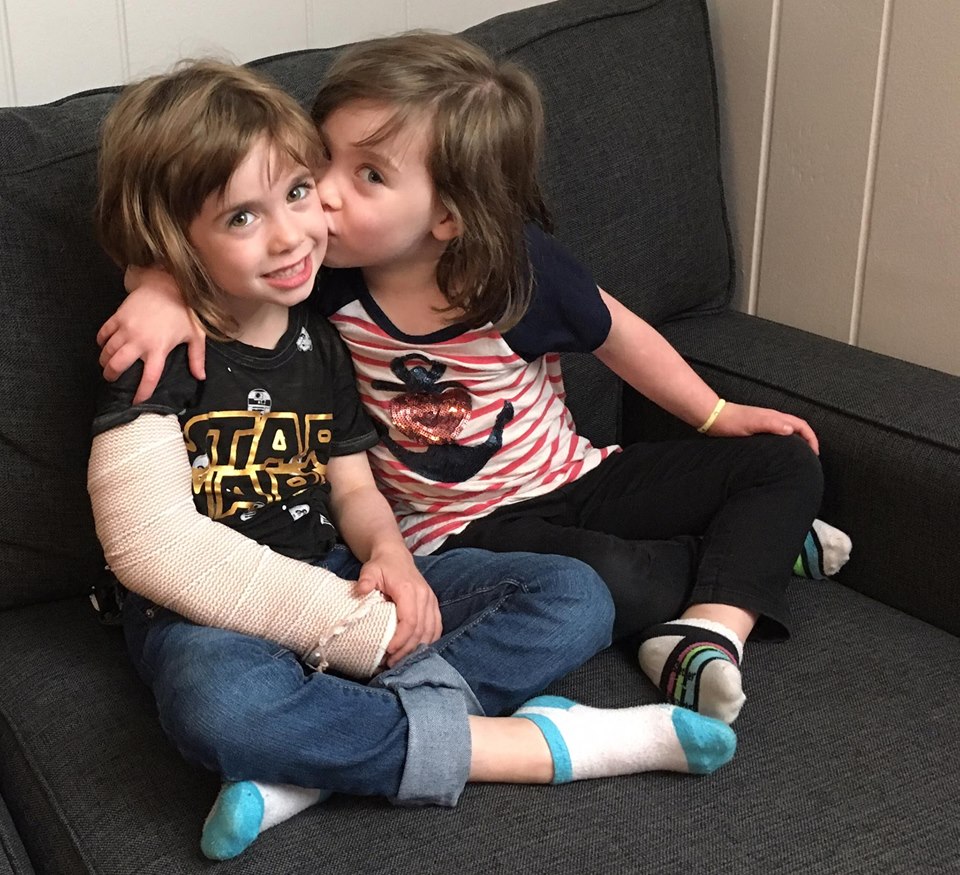
Happy New Year to my grandchildren. If ever there were a reminder of grace, it’s in the face and voices of my son’s children. “We love you, Bela!”

May the new year continue to teach me that focusing on one’s blessings is the best way to live well.


Darkness and Light

From “The Forum,” December, 2016:

“When I’m taking that long walk down that dark hallway, I might as well keep going. It’s just as hard if I turn around, and then where have I gotten?”


There’s no going around it; you have to walk through the pain to get to the other side.

Addiction is a family illness and it affects all family members, not just the addict. There’s sadness, guilt, an inflated sense of responsibility, not to mention shame and secrecy.

I’ve spent years learning how to cope with the reality of my daughter’s drug addiction. But I’m glad I stuck around long enough to get to the other side. I didn’t want to such a cruel disease to destroy another victim. We can all fight the stigma that tears so many families apart.


With My Eye On The Ball

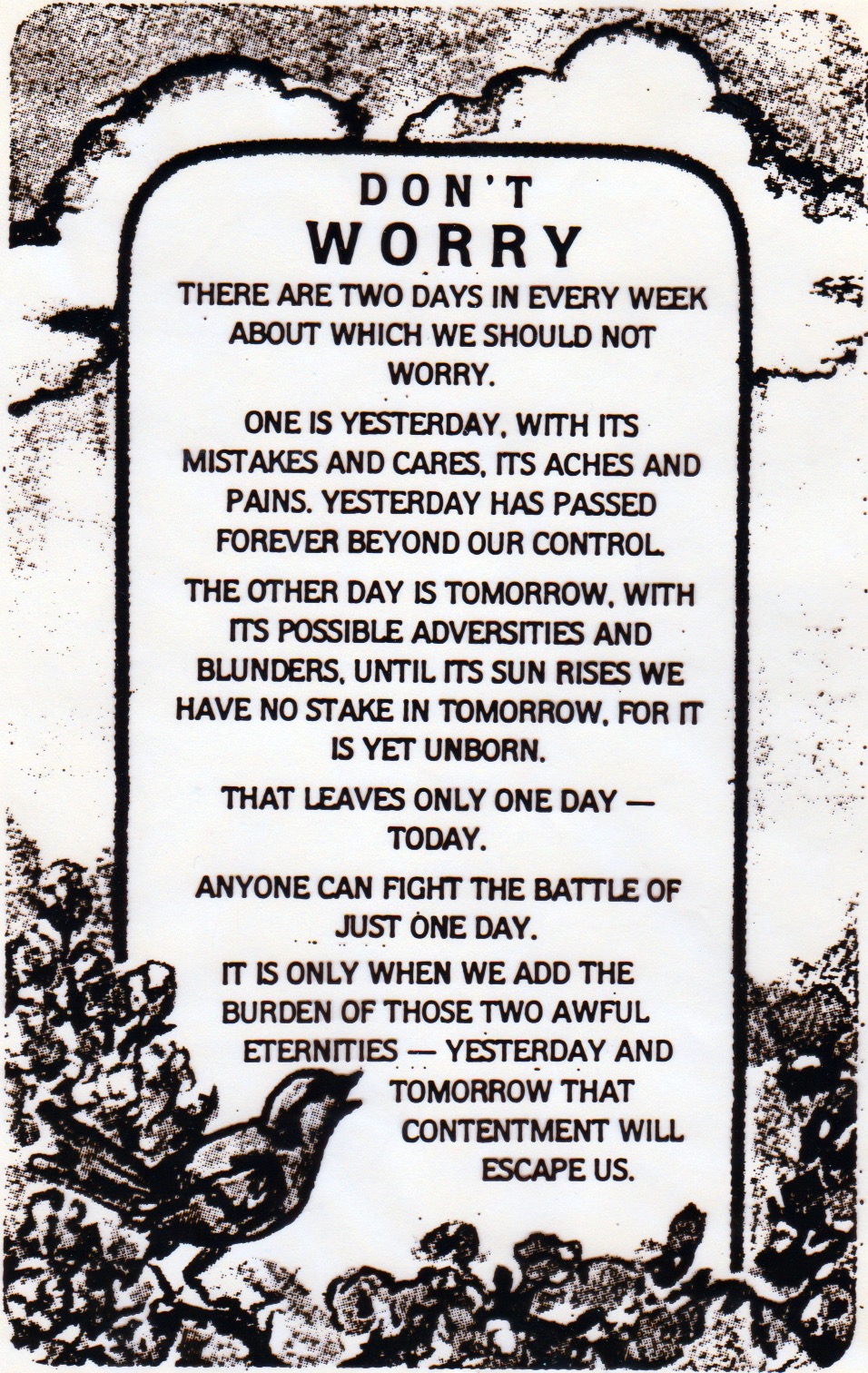
“Worry never robs tomorrow of its sorrow; it only saps today of its strength.”  ~A.J. Cronin


Living in the present moment takes a lot of discipline. To never think about the past? The parts we can’t seem to let go of: our remorse, guilt over things we can’t undo now? We have happy memories, too, but the bad ones often pop up like weeds.

And never look ahead to tomorrow? We have hopes and dreams, fantasies. Sometimes our fears push us to project in negative ways. And that’s just wasteful, though I always rationalize that it’s preparing myself for the worst.

But placing all of my attention on what’s happening right now, without distracting myself with other times, gives me a chance to maximize each moment I’m experiencing. Time is a valuable commodity, and I want to make the most of mine. Watching my daughter and all other addicts lose themselves in the hellish world of addiction has been a powerful object lesson for me.

I’m learning to appreciate the gifts of time and appreciate what’s right in front of me. “Just for today,” I will do the best I can with what I’ve got.


Making It Real

Step Five: Admitted to God, ourselves, and another human being the exact nature of our wrongs.


This is an honest program, and I recognize that I’ve been lying to myself and others my whole life. Shame, stigma, embarrassment were just a few of my rationales. But the lies kept my addictions going. I didn’t have to face them if I didn’t acknowledge them.

Telling someone else was the game changer for me. Other people became the mirrors I needed for valuable feedback. And telling other people made it all real. I could no longer hide in the shadows with my defects.

Bringing them out in the open with witnesses gives us a chance to deal with our defects more honestly and effectively. Freeing myself of some of my defects is critical to my growth and recovery in the program. My defects were roadblocks for me and contributed to my drinking.

I’m glad I’ve come out of isolation and faced myself. Day by day, I’m healing and getting better.


The Power Of Words

From an old Facebook thread, this mother’s comment:

“I am sick of hearing addiction is a disease! It is a choice! I have been clean/sober for over 20 years. I made a choice! I chose to put a needle in my arm. I chose to get drunk because I could not handle what life gave. I chose to get clean and stay clean. Life is all about choices. I did not choose this for my daughter, she did! What I need to do is take care of me today. I choose to let her go no matter how much I love her!”

My response is this: This may be a problem of semantics, but it also involves the old chicken and egg confusion. Which came first?  I think the question “Is addiction a disease or a choice?” oversimplifies: I think it’s both a disease and a choice. The soul sickness that most addicts have—from which they seek relief via drugs, alcohol, food, gambling, etc.—is an emotional condition. Call it depression. But when addicts self-medicate with a substance, then the substance often takes over in the body, creating a craving. Then it’s physical. Then it’s addiction.

So I think the mother on FB is saying that there is choice involved: the choice to fight the disease and go into recovery. Many addicts do just that. But there may be a genetic predisposition in some people to be vulnerable to addiction. In any case, the American Medical Association has stated that addiction is a brain disease. And what people choose to do about it—or any disease—is a matter of choice.