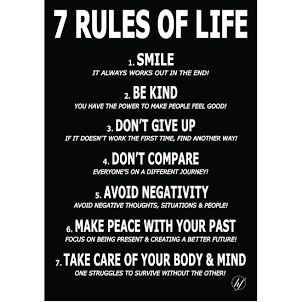
A simple message, but not easy to execute. I do this, not because it comes naturally to me (it doesn’t), but because my experience has shown me over and over again that self-flagellation just keeps me down and out—stuck in a bad place and unable to reach higher. So many years of that negativity and I started to feel that it was my destiny.
Then I was introduced to a recovery movement that changed my life. And it began with what was between my ears.
At what point do we feel restored and able to get up and join the living with confidence and hope for a better life? We are all different and reach that point at different times. I was just sick and tired of being sick and tired. The student was finally ready for the teacher. May we all rise up and reclaim our own wellness.
Pat yourself on the back often. Because you’re worth it!
“As we let go of obsession, worry, and focusing on everyone but ourselves, many of us were bewildered by the increasing calmness of our minds. We knew how to live in a state of crisis, but it often took a bit of adjustment to become comfortable with stillness. The price of serenity was the quieting of the constant mental chatter that had taken up so much time; suddenly we had lots of time on our hands and we wondered how to fill it.”
I’ve learned how to “be still in the stream.” Obsessing over my daughter and living in all her drama was threatening my health. I was suffering from severe PTSD and endured many other negative consequences in my life as a result of my constant worry over something I couldn’t control.
So, I took the first three steps in my recovery program. It was hard to do that because I felt that letting go was giving up on my daughter, not loving her enough anymore. But that’s not how I feel now.
Once, not so long ago, she was a loving daughter to me, a college graduate with her whole life ahead of her. Then, like the great cosmic crapshoot that afflicts millions of families, she fell out of her life and into substance use disorder. She’s been lost to us all for a long time now.
But my daughter, not the substance user that lives in her body, would want me to reclaim my life as I have, and learn to be happy.
I believe this with all my heart. I love my daughter. And love always wins.
From Each Day A New Beginning, by Karen Casey, November 28:
“The idea of God is different with every person. The joy of my recovery was to find God within me.” ~Angela L. Wozniak
Well, there’s a thought…and how empowering! Too much do I rely on the outside world for kindness and goodness and strength. When I don’t always get those things, I feel vulnerable. We’re all flawed human beings, and we don’t always give or receive what’s craved in the moment. All the more reason to maintain a wellspring within ourselves—one of faith and hope for better days.
Isolation is not the answer for us who are in recovery. But neither is too much dependence on how we interact with others. We have to face life’s inevitable disappointments. I try hard to keep my expectations in check, do what I can to make a positive difference in the world, and then let go. I can’t control other people, places or things. But I can try to remain a steady force in my own life and those closest to me.
My recovery has taught me how to manage my ego and remember how small I am in the scheme of things. I have to muster humility in order to take the first three steps (the “God” steps), and humility is knowing my place in relation to God’s: a very small one, like the grains of sand on my beach. Every day I have the ability to marshal my thoughts and inner resources so that I’m not thrown off balance by what’s happening in my small world or in the world at large. All I can do is use the tools of the program as best I can. And, for me, that means keeping God close in my heart and relying on His strength as I watch what’s happening in the world. We all have the power to find peace amid the storms swirling around us. Blessings to all my sisters and brothers!
From Hope for Today, Al-Anon approved literature, January 7:
“One of the first Al-Anon sayings I remember hearing, known as the three C’s, embodies the concept of powerlessness over alcoholism: ‘I didn’t cause it, I can’t control it, and I can’t cure it.’…
’I didn’t cause it’ relieves me of any lingering guilt I may feel: ‘If only I had been a better (fill in the blank), (fill in the blank) would not have become (fill in the blank).’…
’I can’t control it’ gives me permission to live my life and take care of myself…
’I can’t cure it’ reminds me that I don’t have to repeat my insane behavior over and over again, hoping for different results.
I don’t have to search for the magic cure that isn’t there. Instead I can use my energy for my recovery.”
When we love someone caught in the trap of substance use disorder, we want to do everything possible to help. That’s only natural. In the beginning of my daughter’s illness, she enjoyed periods of sobriety, and I gave myself a lot of the credit because I was so supportive. Then, over time, her life went south and she went out again. And I was left to feel “What did I do wrong? I’ve been so supportive!” Again, over time, I learned in MY recovery group that her illness had nothing to do with me. And her facing down her demons and reclaiming her life was even less of my responsibility.
That’s where the rubber hit the road for me. That’s where I had to do the most difficult: lean into acceptance, let go of my own daughter and pray she finds her way back home. A friend who’s not walking in my shoes used to chide me, “Don’t just sit there; DO something!”
Well, I’ve done all I can. Maybe the seed of recovery will sprout in her. But for now, I choose to let go and let God. And I realize there’s a lot of strength in surrender.
Excerpt from my forthcoming memoir, Gene and Toots: A Love Story
“When my daughter was in trouble, my instinct was to rescue and protect her from harmful consequences. It was losing my child to the torture of substance use disorder that led me, quite accidentally, into confronting myself and the landscape of all my own inner conflict. And in so doing, ironically, it was I who came away more healed, less broken, and more able to accept—with grace—the disappointments in my life. Now, after years of recovery, I know that those same consequences might have been her best teachers. This is precisely where faith might have helped me; I didn’t have any when I most needed it.”
From Each Day A New Beginning, Conference Approved Literature, January 9:
“’The Chinese say that water is the most powerful element, because it is perfectly nonresistant. It can wear away a rock and sweep all before it. ‘ ~Florence Scovel Shinn
Nonresistance, ironically, may be a posture we struggle with. Nonresistance means surrendering the ego absolutely. For many of us the ego, particularly disguised as false pride, spurred us on to struggle after struggle.”
Well, I don’t do anything absolutely, but my time in recovery has strongly encouraged me to remain right-sized in my thinking. EGO—Easing God Out—is a useful reminder that I don’t always know what’s best in any situation. But my resistance often keeps me stuck.
Whether it’s wondering how to cope with my addicted daughter, or wondering how to continue facing the loneliness of Covid, or determining what to do about a barking dog in the wee hours of the morning, all of these problems require some level-headed judgment, which I don’t always have.
So I find the power of prayer to be a wonderful relief and solution to my thinking that I have to fix every problem.
If it’s a situation I can control, I’ll try to do something.
If it’s not something I have the ability to control, I’ll try to let it go.
And determining which is which, needless to say, is our biggest challenge.
Happy New Year! Regardless of the storms swirling around us, I will try to remember what’s most important in life. I ask myself, “How important is it?” before I work myself up into a lather! I’ll try to slow down and not overreact to events. I’ll try to keep things in perspective and maintain a healthy attitude.
Let us all try to live well and hope for the best in our world.
“A slump can go on for days. We feel sluggish, unfocused, and sometimes overwhelmed with feelings we can’t sort out. We may not understand what is going on with us. Even our attempts to practice recovery behaviors may not appear to work. We still don’t feel emotionally, mentally, and spiritually as good as we would like.
In a slump, we may find ourselves reverting instinctively to old patterns of thinking, feeling, and behaving, even when we know better. We may find ourselves obsessing, even when we know that what we’re doing is obsessing and that it doesn’t work.
We may find ourselves looking frantically for other people to make us feel better, the whole time knowing our happiness and well-being does not lay with others.
We may begin taking things personally that are not our issues, and reacting in ways we’ve learned all too well do not work.
We’re in a slump. It won’t last forever. These periods are normal, even necessary. These are the days to get through. These are the days to focus on recovery behaviors, whether or not the rewards occur immediately. These are sometimes the days to let ourselves be and love ourselves as much as we can.
We don’t have to be ashamed, no matter how long we’ve been recovering. We don’t have to unreasonably expect “more” from ourselves. We don’t ever have to expect ourselves to live life perfectly.
Get through the slump. It will end. Sometimes, a slump can go on for days and then, in the course of an hour, we see ourselves pull out of it and feel better. Sometimes it can last a little longer.
Practice one recovery behavior in one small area, and begin to climb uphill. Soon, the slump will disappear. We can never judge where we will be tomorrow by where we are today.
Today, I will focus on practicing one recovery behavior on one of my issues, trusting that this practice will move me forward. I will remember that acceptance, gratitude, and detachment are a good place to begin.”
From Each Day A New Beginning, Karen Casey, October 1:
“’Women are often caught between conforming to existing standards or role definitions and exploring the promise of new alternatives.’ ~Stanlee Phelps and Nancy Austin
…Recovery means change in habits, change in behavior, change in attitudes. And change is seldom easy. But change we must, if we want to recover successfully.”
This applies to both substance users and to those who love them, for we all need recovery.
At first, many years ago, I had no idea that loving a substance user had the potential to make me sick: denial, guilt, obsession, depression and anxiety; it would be hard for a parent to not experience one of those things.
But over time, I realized that I was doing things I never would have done under normal circumstances. These were not normal circumstances, and I let myself justify a number of things, the most damaging being not making my daughter accountable for her actions. I enabled and overprotected, which stood in the way of her growing, changing, and recovering.
Fortunately for me, I have adopted many new attitudes from sitting in the rooms and enjoying the support of many other parents. My knee-jerk habit of rescuing has stopped, and my behavior has changed toward everyone in my life. I believe that it has a lot to do with my inventory work in Al-Anon, but others find the ability to change through other means. It doesn’t matter where we gain our strength. The important thing is to make the necessary changes that will enable us to live well and be happy—because we all deserve to have a good life.
An old middle school friend of my daughter’s from 30 years ago found me on Facebook this week. Then she called me on Facetime from North Carolina.
“Jaime, omg, how are you? What are you up to?”
“Oh, I’ve got three boys and I’m doing well. But I’ve been wanting to get in touch with Annie.”
So I told her a short version of our story.
“I’m so sorry for the hell you’ve been going through, Marilea. Please know that I remember her to be the best kid, loyal and kind. It’s hard to believe how drugs have changed her so completely. If you ever reconnect with her, tell her I miss her and want to reconnect.”
Christmas is always hard for this mother, no matter how much recovery I have. I’m only human. But Jaime’s phone call made me feel better. It was a real time reminder that I once had a daughter who was doing pretty well in the world. She did some things to be proud of. She had friends who remember her like she was before drugs. And family.
Keeps things in perspective. We all have kids who were once doing well. It wasn’t all bad. As I decorate my Christmas tree, I proudly add the decorations she made in preschool. I remember the good times, and I smile when I look at the tapestry she made for me.