My friend from my old Tuesday night Al-Anon meeting in Virginia sent me an email. He said he had just read my book and took it to his son to read who is serving a six-month sentence in jail. Justin was so moved by the book that he has decided to write his own story. I am thrilled to have been a source of inspiration for him, because just the act of writing my story has been healing for me. Likewise, it could prove to be the catharsis Justin needs to finally face his demons and walk away from drugs.
David Sheff’s (Beautiful Boy, Clean) son, Nick, a meth addict, wrote his own story, Tweak, which was very successful.
We all have a story to tell. And even though we’re not best-selling authors, our stories have value especially to those of us walking down the painful road of substance use disorder. I hope Justin and many other substance abusers out there write their stories. More of us need to get our stories onto Amazon. The shame and stigma of this cruel disease will fade in time if we all come out of the shadows and tell our truths.
I raised my family with the best of intentions. I loved my kids to the moon—still do—but I also felt completely responsible for them. That’s understandable when they’re children and young adults. But at some point—and this place is different for all of us—I feel it’s important to relinquish our responsibility and allow our children to be responsible for themselves.
This gets so complicated because mental health issues so often accompany active substance use disorder. There is so much for our children to shoulder, and we want to help.
This understanding is never more critical than when our adult children struggle with this disease. If we are hampered by guilt—a truly crippling emotion—we might allow ourselves to feel overly responsible. We keep moving our own healthy boundaries to accommodate the substance abuser. This in turn puts us at risk of becoming enablers. And that downward spiral will continue—until we break free of it. It’s a hard journey we’re on, and we need help too.
”We didn’t cause it; we can’t control it; we can’t cure it.”
“I am not afraid of storms for I am learning how to sail my ship.” Louisa May Alcott
I grew up in Massachusetts on a lake, and we sailed every summer. Boats and water are a part of my narrative because it’s where I started my life. But it was never really smooth sailing.
Twenty-two years ago my world turned upside down. My boat capsized as I started watching my daughter tumble down the rabbit hole of substance use disorder. Mind you, I was living a wonderful life, not perfect, but whose is? I was a hardworking single mother with three kids who seemed to be doing well. Just one of millions of women doing their best for their families. And then I got tagged. Annie became another statistic.
I got sucked into a perfect storm of my own shortcomings colliding with my vulnerable daughter and her addictive character. I was utterly guilt-ridden, and that crippled me and my judgment. I enabled her far too much, cradling her in one safety net after another. I inadvertently prevented her from facing consequences and learning from her behavior.
In the end, by taking on far too much responsibility for my daughter’s illness, I had such severe PTSD/clinical depression that I felt compelled to retire. That was my bottom, when I knew I had to change my thinking and some behaviors in order to reclaim my life. Annie is a wounded soul split in half—the addict and all the life that entails; and my loving daughter. I believe with all my heart that my loving daughter would want me to survive losing her. And my survival is how I choose to honor her.
I got help in the rooms of twelve-step recovery; there are many, many of them, in every city and here on Facebook. The kind of help I received involved a lot of reflection and reframing my life. I learned not to fear looking back on my childhood, that the answers to much of my coping skills lay there. As I moved forward reflecting on my life as a young mother, I understood why I behaved as I did much of the time. And I awarded myself compassion and forgiveness for doing the best I could in difficult times.
Now I feel blessed, if only because the ground under my feet is more solid. The storms in my life have rocked me many times over the years, but I’m learning how to weather them. When we lose something as precious as a child, everyone and everything in our lives loom larger in importance. It’s a terrible irony of life that the intensity of our joy often comes to us at the cost of much pain.
I have a snapshot of me and Annie on my aunt’s sailboat many years ago just before she started tumbling away from us all. We’re both smiling, and it doesn’t make me sad to look at it. On the contrary, it reminds me of the fragility of life and how more than ever it’s important to live with intention. I think I sleepwalked through much of my early life, entirely unaware of who I was. But now, thanks to my years of work in recovery, I have learned a better way to live. We all pass through storms in the course of our lives. But they don’t have to destroy us. We can seek out healthier solutions and work them into our lives.
“We are made to persist; that’s how we find out who we are.” ~Tobias Wolf
“Wanting to control other people, to make them live as we’d have them live, makes the attainment of serenity impossible. And serenity is the goal we are seeking in this serenity program. In this life.
We are each powerless over others, which relieves us of a great burden. Controlling our own behavior is a big enough job…”
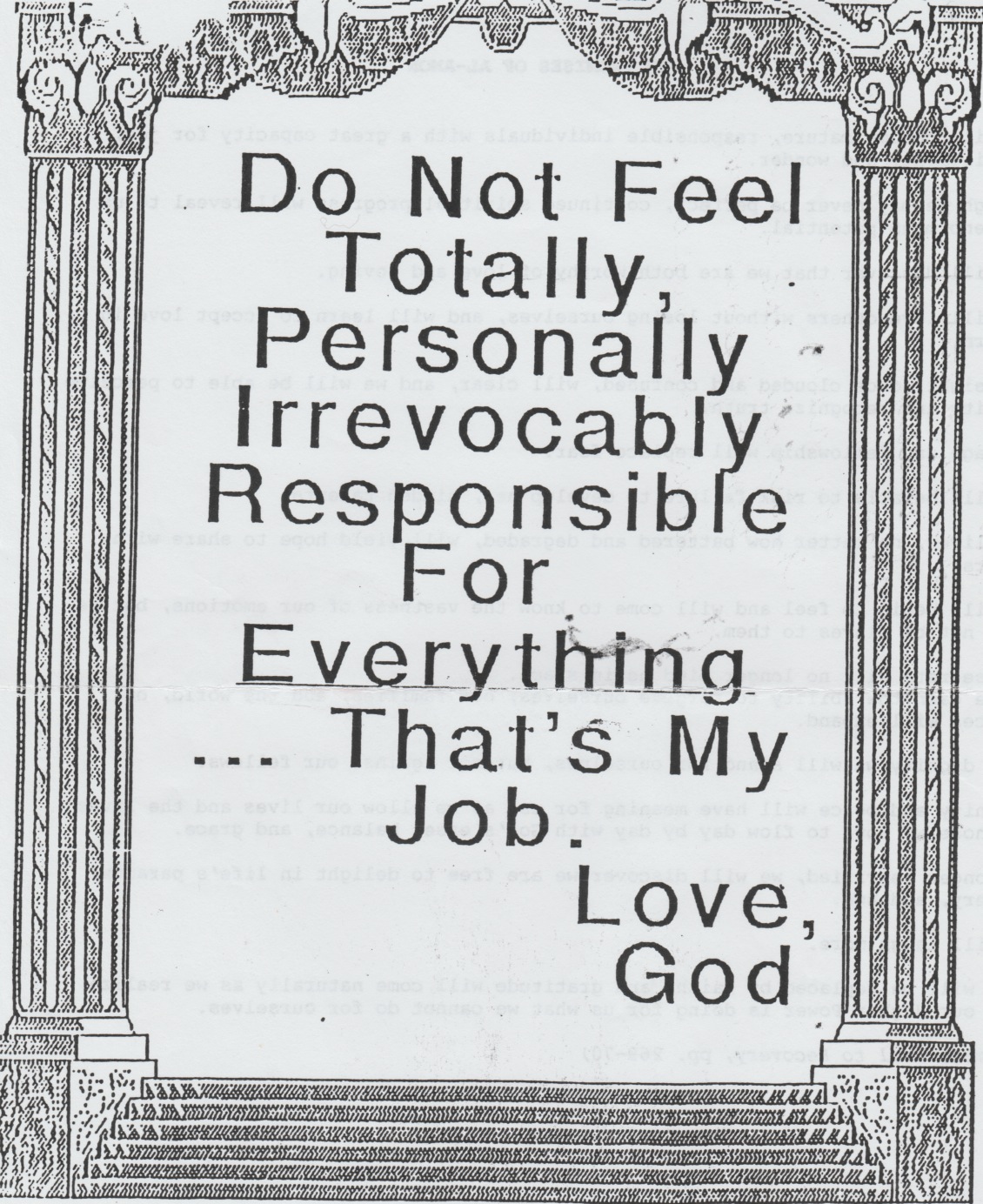
When I took the Third Step, and turned my concerns about my daughter over to the God of my understanding, I felt a freedom that I’d never felt before. I stopped trying to control everything so much, stopped trying to play God when that’s not my job. With this freedom comes the faith that things are unfolding as they are meant to, without any help from me. Acceptance of life on life’s terms gives me peace—and the energy to open my eyes and keep moving.
Help me this day to understand the true meaning of powerlessness.
Remove from me all denial of my loved one’s addiction.”
The first step is probably the most important one in assuring our recovery from the effects of another’s substance use disorder. And it’s because I refused to take it that it took me so long to start to recover. I simply wouldn’t accept my powerlessness over my daughter’s disease. I felt as though I would be dropping the ball and appearing not to care about her. I felt that I had to do everything in my power to save her. “Power,” I realized later on, that I didn’t have.
So, deep pockets enabled me to put her through four rehabs. Deep pockets also had me paying her rent, paying off her loans, paying back the creditors she got into trouble with. All my “help” simply gave her more money for drugs. In short, deep pockets can be dangerous if used for the wrong things. She might have learned something from the consequences of her actions if I hadn’t kept getting in the way.
So yes, my life had become unmanageable. I love my daughter very much. And I kept making things easy for her. But we can enable our children to death. Now I’ve let go of all my attempts to control her and her disease.
And I feel as though the weight of the world has been lifted from my shoulders.
“One of the gifts I have received from Al-Anon is learning how to maintain an attitude of gratitude. Before the program I didn’t really understand the true nature of gratitude. I thought it was the happiness I felt when life happened according to my needs and wants. I thought it was the high I felt when my desire for instant gratification was fulfilled.
Today…I know better. Gratitude is an integral part of my serenity. In fact, it is usually the means of restoring my serenity whenever I notice I’m straying from it.
Gratitude opens the doors of my heart to the healing touch of my Higher Power. It isn’t always easy to feel grateful when the strident voice of my disease demands unhealthy behavior. However, when I work my program harder, it is possible.
‘Just for today I will smile…I will be grateful for what I have instead of concentrating on what I don’t have.’”
Accepting life on life’s terms is hard. My daughter has been a substance abuser for twenty-two years, and I grieve the loss of her in my life every day. The five stages of grief: denial, anger, bargaining, depression and acceptance—I know them all, and not always in that order.
My path to recovery involved a lot of denial in the beginning and, as it said in the reading, “the voice of my disease demanded unhealthy behavior.”
So I’m grateful now for the serenity and peace that I have in my life. Acceptance is the gift I give myself every day when I let go and give her to God. When I remember that my glass is half full, it dulls the ache from losing my precious daughter. She’s still alive, but I haven’t seen her in more than eleven years. When they say that there’s always hope, I agree: as long as she’s alive there’s hope for her to recover. But more importantly, there’s hope for me to move on with my life and focus on my blessings. I deserve to be happy, and that’s the only thing that I can control.
In recovery, we learn to profoundly adjust our expectations, hard as it is. We raised one child, and now we have another. We are all too aware of the change that drugs have produced in our children. A parent wrote in Sharing Experience, Strength and Hope ( the SESH book) a very revealing statement, something I could have written myself. It is a key to understanding my story, my mother and father’s stories, and my daughter’s painful struggle:
“I expected my children to be perfect, to always do the right thing. I tried to control them by giving them direction and making them do things in a way that I felt was correct! When they didn’t, I could not handle it.
I could not accept their drug use and I felt that their behavior was a reflection on me. I was embarrassed for myself and scared to death for them. I became so distrusting of my children that I showed them no respect. I would meddle and invade their privacy looking for any excuse to challenge and confront them.
When I came to Nar-Anon, I learned that my interference and my attempts at controlling them were actually standing in the way of their recovery. I learned to let go of the control I never had in the first place.”
In an earlier blog, “Redemption and Freedom,” I said, “I would finally, thank God, let go of the oppressive burden I was placing on my daughter by demanding she get well so that I could be OK.” This is a difficult statement for some of us to make.
I’m very codependent; my daughter’s active drug addiction shook me to the core and made me decidedly unwell. Her illness had the power to ruin my day (and my life) before I got into a recovery program and started practicing the concept of detachment with love.
This concept has placed me at a healthy distance from my daughter so that I could view her situation with some objectivity and respond to her with intelligence and compassion. I’m very grateful for the education I’ve received in the rooms of recovery. I will always love her and I grieve the loss of her. But there are other people in my life, and I want to stay well for them. Thank you, Nar-Anon, for helping me reclaim my life!
From In All Our Affairs, Making Crises Work For You, Surrender:
“‘Let go and Let God.’ It sounds so simple. But when our circumstances or the circumstances of those we love weigh heavily on our minds, we may have no idea how to do it. Some of us struggle with the very idea of a Higher Power. Others begin to question long and deeply held beliefs, especially in stressful times…
Many of us review the same scenario again and again, looking for that elusive answer that will solve everything, obsessively wracking our brains for something that we could do differently or should have done differently in the past…As long as there is a chance of figuring out a solution, we reason, we should keep trying…We may secretly feel that this problem is too important to trust to God, as if we had the power to prevent God’s will from unfolding by the mere exercise of our resistance. We fear that if we surrender, anything could happen—
Actually, anything could happen whether we let go or not. It is an illusion that as long as we cling to the situation we have some control…Surrender means accepting our powerlessness to change many of the realities in our lives…It means trusting instead in a Power greater than ourselves. Faith has been likened to being in a dark tunnel and seeing no glimmer of light but still crawling forward as if we did.
Though our circumstances may seem dark indeed, when we turn to a Higher Power rather than to our own stubborn wills we have already begun to move toward the light.”
“Moving toward the light…” I really love the sound of those words. What could be darker than watching my daughter self-destruct over the course of twenty-two years? How have I learned to “dance in the rain,” even as she has continued to slip away?
My resistance training at the gym has shown me that pain comes from putting resistance on the force exerted, and that has served me in strengthening my body. But my spiritual life demands just the opposite. My strong will and determination to save my daughter from substance use disorder was instinctive; it would be counterintuitive NOT to step in and interfere in my child’s self-destruction.
However, once I became educated about the nature of addiction as a brain disease, I realized that other than offering my love and emotional support, there was very little I could do. I did send her to four rehabs, which bought her some time. But my efforts were not enough. At what point do we need to make our adult children responsible for their own recovery from this cunning disease?
Before I went into recovery, I was pretty lost. On the outside, my life seemed to be rolling along well. But on the inside, I was insecure and sad. I dealt with these feelings in unhealthy ways, but didn’t feel much pressure to change them. I never missed a day of work, and I appeared to be fine. But appearances can be deceiving. Nothing had yet occurred to call my choices into question. Nothing had happened yet to push me out of my complacency.
But when my middle child fell ill with substance use disorder, after I had tried and failed over and over again to save her, I broke. The carefully manicured life I had been living was a treasured glass from my cupboard, smashed onto the kitchen floor. There were many little shards, and some big ones. I cut my fingers cleaning it up.
My recovery fellowship comes with a philosophy that teaches me many different things. And one of those things is to forgive myself and others for transgressions inevitably committed in our lives. Our common humanity dovetails at every meeting I go to, where we encourage ourselves to face our defects, let them go, and move on.
For years, I held on to mine to punish myself for my part in Annie’s disease, and most importantly, for failing to “save” her. I have learned, gratefully, that my daughter suffers from substance use disorder, as do I, and I could no more save her from it than if she’d had diabetes. I simply don’t have that power.
So I try to stay away from martyrdom and self-pity, because neither of those feelings will help Annie get well, and they hurt me a great deal. That’s where the weeds are. They muddy the waters; they keep me angry and sad. When I steer clear of them, it takes some of the sting out of losing my daughter. I can more easily open my heart to what remains in my life.
Staying in the weeds—a murky place— prevents me from changing and growing. My recovery fellowship provides the tools to accomplish those two things, with gentleness and kindness. It’s hard, hard work. But when I see positive results in real time I’m encouraged to keep at it. There’s no graduation from this school of life.
The miracle of my recovery is that my eyes can see my life through another lens now, one full of gratitude, humor and love. The fruits of my recovery rest on these three things.
Substance use disorder doesn’t discriminate. Before my daughter was swallowed up in it, she was a successful ten-year-old gymnast competing in England while we were traveling in the Foreign Service and living in Greece. She was a gifted artist. And she graduated from college with a B.A. in Journalism. When she was 21, it all fell apart.
I no longer speculate on “Why Annie?” Rich, poor, educated or not, substance use disorder can strike anywhere. And sometimes there is a gene component—four generations in my family—but not always.
The particular poignancy of this mother’s story is that Annie and I mirror each other: we both suffer from substance use disorder. So my story has a bit of a spin to it. It’s all graphically portrayed in my books. I’m not as detached as many parents without such baggage. My guilt and overinflated sense of responsibility consistently prevented me from being objective or from acting intelligently. I had to let go of my remorse before I could be helpful to her. And I had to value myself enough first in order to do that.
That came from working the steps of my recovery program. Self-forgiveness is critical to my ability to move on. Mine has been a classic redemption story.
I have learned to live well, despite the fact that my daughter is estranged from me. Many fellow parents, myself included, are primarily interested in the magic bullet that will save our children. But I’m glad I stayed in recovery long enough to learn that even though I’m powerless to save my daughter, I can still save myself. There are other voices in my world who call me: other children, grandchildren, family and many friends. I want to listen and live well for them. That is the message of my story and many others’: that even though I’m weathering one of a parent’s worst nightmares, I’ve learned that there’s no glory in martyrdom, and that I’ve earned the right to live happily, whether Annie recovers or not. Life goes on, and we with it. I’ve lived a blessed life, and only through my work in recovery have I found the good sense to recognize and be grateful for that.
As I’ve watched Annie slipping away all these years, I’ve learned to view my life through a different lens. The tools of recovery have taught me how to be grateful for what I have, how to let go of people and situations that I cannot change, and to have faith in something greater, wiser, and more powerful than I am.
Losing my child to substance use disorder did break me a few years ago, and in my brokenness and despair I turned toward the light that had always been there. I’m so grateful that I still had the eyes to see it.