Little Heroes

From Courage to Change, Al-Anon approved literature, May 31:

“Legends have often told of spiritual journeys in which the hero must face great challenges before gaining treasure at the journey’s end. As the heroes of our own stories, we…have also embarked upon a spiritual journey—one of self-discovery.”

I never thought of myself as a hero. What I am is a recovering addict/alcoholic with an AD who I haven’t seen in eight years. Those are the facts. Have I been challenged by the reality in my life? Of course! But I’m still here. I sleep at night. In spite of my struggle with Annie, I manage my life and relationships better than I ever have.

Before recovery, there were two Marilea’s: the outside one and the inside one; and they didn’t match. Like many people, I wore masks to keep up appearances. But I am learning in the rooms to face myself with more honesty, to let go of habits that weren’t working for me anymore, and in the process I discovered new things about myself, things that give me hope for the future.

People fear change, so it takes courage to do things differently. The biggest and most fundamental change in my life has been my ability to embrace an entity outside of myself (call it God, HP, or a tree) to guide me through the inevitable difficulties in my life.

Before I took the first three steps—the “God” steps—I was entirely self-reliant, feeling and appearing competent, but always frightened on the inside. My “solution” had always been excessive use of various substances—from food to alcohol—to deal with my fears. But that stopped working for me, and I needed help to implement the change I needed. I was desperate enough to accept that my best thinking got me into the rooms of recovery. I was probably my own worst enemy, and I needed help. I had tried so many things, from yoga to many self-help books.

But the one thing missing in all of my solutions was a healthy dose of humility. I still needed to think I was in charge, which, of course, is what got me into so much trouble. I was delighted, finally, to let go of my ego just enough to trust in God to help me manage my life. This was the piece of the puzzle I had been yearning for. My Spirit now fills in the holes that substances used to cover up, and I’m grateful.  

Two-Stepping The Twelve-Step

Memoir Excerpt from Stepping Stones: A Memoir of Addiction, Loss, and Transformation:

 “’Marilea, why don’t you try a recovery meeting?’ my counselor gently advised me. She had heard me week after week moan about Annie turning into a monster I didn’t recognize anymore. It was terrifying; sleep eluded me.

‘Oh no, that’s not for me,’ I responded, echoing my mother from thirty years before when my sister tried to get her to do the same thing.

‘Well, I think it will help you to be around people going through the same thing.’

Thinking about it for a few weeks, though, I took her advice and started going to a meeting on Saturday mornings. Gene also felt it was a good idea.

And so began a long period of faithfully going to several twelve-step meetings, but essentially paying lip service much of the time, particularly to the first three steps, because I was nothing if not the biggest control freak around.

Step One: Admit my powerlessness? Never! I brought her into the world. It was my job to protect and save her.

Step Two: Believe that God could restore me to sanity? What’s insane about trying to save my child?

Step Three: Turn my will over to God? No way! I had to stay in control.

As a child, I took care of my own needs. I’d asked for company, hollered for attention, hoped for forgiveness, but was often ignored. So I became compulsively self-reliant: CSR, I humorously say at meetings. And much of that self-reliance, attempting to appear competent, looked like arrogance.

It took me a long time before I found the humility to get a sponsor. Part of me didn’t want to ask for help; an even bigger part thought I didn’t need help. It was Annie, I argued, who needed help.

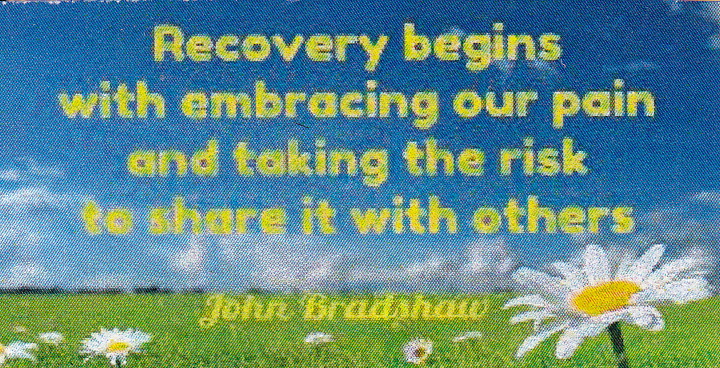
Humility, I discovered, was a tremendous leveler, and it would bring me closer to what I’d been missing my whole life: being part of a community of equals.

But without being honest with myself and others, I remained isolated on the outside, looking in.”

My Glass Is Half Full

From Hope For Today, Al-Anon Family Group, CAL, January 23:

“One of the gifts I have received from recovery is learning how to maintain an attitude of gratitude. Before the program I didn’t really understand the true nature of gratitude. I thought it was the happiness I felt when life happened according to my needs and wants. I thought it was the high I felt when my desire for instant gratification was fulfilled.

Today…I know better. Gratitude is an integral part of my serenity. In fact, it is usually the means of restoring my serenity whenever I notice I’m straying from it.

Gratitude opens the doors of my heart to the healing touch of my Higher Power. It isn’t always easy to feel grateful when the strident voice of my disease demands unhealthy behavior. However, when I work my program harder, it is possible.

‘Just for today I will smile…I will be grateful for what I have instead of concentrating on what I don’t have.’”

Accepting life on life’s terms is hard. My daughter has been a substance user for nearly twenty years, and I grieve the loss of her in my life every day. The five stages of grief: denial, anger, bargaining, depression and acceptance—I know them all, and not always in that order.

My path to recovery involved a lot of denial in the beginning and, as it said in the reading, “the voice of my disease demanded unhealthy behavior.”

So I’m grateful now for the serenity and peace that I have in my life. Acceptance is the gift I give myself every day when I let go and give Annie to God. When I remember that my glass is half full, it dulls the ache from losing my precious daughter.

She’s still alive, but I haven’t seen her in eight years. When they say that there’s always hope, I agree: as long as she’s alive there’s hope for her to recover. Many, many addicts do. But more importantly, there’s hope for me to move on with my life and focus on my blessings. I deserve to be happy, and that’s the only thing that I can control.

Taking That Leap

“’Joy fixes us to eternity and pain fixes us to time. But desire and fear hold us in bondage to time, and detachment breaks the bond.’ ~Simone Weil

We live both in the material realm and the spiritual. In our material dimension we seek material pleasures, inherent in which is pain. Our human emotions are tied to our material attachments, and joy, at its fullest, is never found here. Real joy lies outside of the material dimension while living fully within us too, in the secret, small place inside where we always know that all is well.”

That secret, small place that is easily hidden by the distractions of our (material) lives? Unless we are Buddhist monks living in Tibet, we are just humans like everyone else, wondering how to get the bills paid. We, in the human dimension, have so many concerns that keep our minds busy. And that is why, when our concerns weigh us down, the spiritual life is comfort and relief.

The first three steps are keys to getting me started on the spiritual journey.  The acceptance (of things I can’t control) that comes with Step One is humbling. But unless it’s fully taken and I put my ego and will in a back drawer, there’s no point in moving forward with the steps. Having admitted my powerlessness, then, I need help to carry the pain I have just assigned myself. So I come to believe that some power will restore my mind to a saner pace. And finally, of course, I take that giant leap of faith by asking that Being to carry the burden for me.

This is the relief I feel every time I take Step Three. This is the leap of faith I need to make to feel joy in the material domain. More prayer, more Eleventh Step, more peace and serenity  when I remember how small I am in the scheme of things. When my HP remains large in my life, I have faith that all will be well.

The Gift Of Life

From Each Day A New Beginning, Conference Approved Literature, November 7:

“’…we will be victorious if we have not forgotten how to learn.’ ~Rosa Luxemburg

For most of us the struggle was long, painful and lonely to the place we are now. But survive we have, and survive we will. The times we thought we could go no further are only dimly recalled…Step by Step, we are learning to handle our problems, build relationships based on honesty, and choose responsible behavior.”

Probably the most important factor in my recovery is the ability to remain teachable. We can become set in our ways, “you can’t teach an old dog…,” and older people sometimes can be resistant to change. This is all fine for those of us who have a life without serious challenges.

And then there are the rest of us.

My years in recovery have, out of necessity, showed me how to open my mind and heart in an effort to be forever teachable, to be always willing to learn the lessons that life puts before me. Without such flexibility and the willingness to view things differently, to let go of ideas and patterns that were bad for me, I would still be stuck in a life that was fundamentally unhappy. I say “fundamentally” because on the outside many things looked good. But on the inside, I was screaming.

Eighteen years ago, I entered the rooms of recovery out of a desperate desire to save my daughter. But after years of trying, I ultimately couldn’t provide her with the magic bullet to free her of her substance use disorder. That magic bullet doesn’t exist. My daughter has and always has had the power to recover. That’s one of the many things I learned in the rooms. And, over time, as I learned to turn the mirror back on myself, I have learned to face a number of things that were getting in the way of my own capacity to live well.

What I’ve learned was that life is a gift, and nowhere has that been made clearer to me than by watching my loved one throwing it away. My first instinct, of course, was to put myself between Annie and her bad choices. But that only made me sick and forced me into early retirement. That was my bottom.

Well, at the bottom I had two choices: either stay there—or lift myself up. I’m happy that I chose to keep on living. There are other people in my life who rely on me, other ways I can try to be of service. I’m not the first adult child out there, not the first parent to lose a child to this cruel disease. There are millions of us out there, a vast community of equals reaching out to help one another. And we do, right here sharing with one another, a daily reminder that we are not alone.