From Each Day A New Beginning, by Karen Casey, March 14:
“’The child is an almost universal symbol for the soul’s transformation. The child is whole, not yet divided…When we would heal the mind…we ask this child to speak to us.’ ~Susan Griffin
Perhaps “the child” is a metaphor for a spiritual guide, like our own higher power, that can help us in our journey toward self-acceptance.
‘I may not be perfect, but parts of me are excellent.’”
I love the freedom in this quote. For so much of my life, I’ve been a slave to appearances, to perfectionism, to measuring up to someone else’s arbitrary standards. But my outside never matched my inside, and what a relief to be able to shed my masks and just be who I am, warts and all.
This journey toward self-acceptance has been a long one, and I’m grateful. The twelve steps, in my mind, are terrific character builders. Once I muster (with difficulty) taking the first three steps, the “God Steps,” my work is cut out for me. This is where many people leave. It’s hard work to look in the mirror and look at my defects. Holding onto resentments, too, one of our biggest Waterloos, and our difficulty with accountability blinds us to what we need to change. But once we get over that hurdle and start clearing out the wreckage of our past, the final steps seem like a welcome refuge from the storms of our lives.
The child in us is kind and forgiving. “When we would heal our minds,” we can listen to the voice of the child in us.
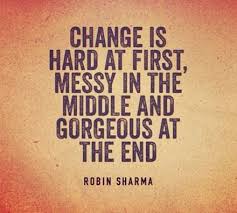
“’Nobody told me how hard and lonely change is’ ~Joan Gilbertson
…Honest self-appraisal may well call for change, a change in attitude perhaps, a change in specific behavior in some instances, or maybe a change in direction…(But) We find some comfort in our pain because at least it holds no surprises…Courage to change accompanies faith. My fears are telling me to look within to the spiritual source of strength, ever present but often forgotten.”
When I joined my recovery fellowship, my focus was firmly on my daughter. She had a life-threatening disorder, and I wanted to help her. So I helped. And I helped. And I helped…I had the best of intentions, but I needed to step back and reflect upon what, besides protecting her, was motivating me. My fear was getting in the way.
I needed to get help so that I could manage the situation better. It took me a long time to realize and accept that I was making a bad situation much worse. And this was happening because of my own unrecognized problems. Once I saw them and how they affected, not just my relationship with Annie, but with other important people, I found the willingness to work on myself and improve my relationships with others.
One day at a time, I’m still trying. I’m far from perfect, but I’m trying to be my best self. At the end of the day, that’s the only self I can control.
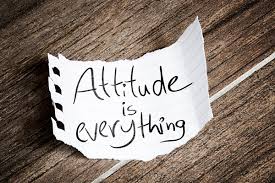
“The longer I live, the more I realize the impact of attitude on life. Attitude, to me, is more important than facts. It is more I important than the past, than money, than circumstances, than failures, than success. The remarkable thing is we have a choice every day…We cannot change the past…we cannot change the fact that people will act in a certain way…Life is 10% what happens to me and 90% how I react to it.” ~Charles Swindoll
I joined Al-Anon to help my daughter with her substance use issues. But I ended up helping myself so much more. It wasn’t my intention, but I’ve grown a lot in my efforts to heal from a lifetime of living around people with substance use disorder, including myself.
Growing up around alcoholism, and surrounded by a plethora of negative attitudes, I’ve had to unlearn those scripts and rewrite them, as though I were reparenting myself. It is certainly true that our attitude can move mountains…or level them.
I have had a difficult situation with my daughter for years. Early on I was either in denial or hardened in my grief at the loss of Annie. But if I try to keep a healthy perspective on it, if I don’t obsess about it, it won’t control me. I try to keep my heart open to the gifts of this program. Therein lies my happiness. And so, one day at a time, I try to keep a positive attitude, keeping the focus on myself, with gratitude and joy in all I have.
This is a miraculous program that “works if I work it.”
“One weekend before we left the country, telling Angel he was on his own with the kids, I drove East to be by the sea. In Ocean City, I got a cheap hotel room, a cheap bottle of vodka, and spent my time numbing myself. Instead of walking on the beach at the ocean I love so well, instead of grabbing a bag and adding more souvenirs to my beautiful collection, I lay on my bed, drank vodka straight out of the bottle, and passed out.
I might as well have stayed in a cheap motel near my own house.
In a fog most of the time, eating junk food from the boardwalk, I ran away from my life. I left my “shell” for the weekend, ventured off by myself, as empty coming out of a bottle as I was going into it.
I learned nothing, gained nothing from escaping for a few days other than missing my children terribly. I was still as hollow as the bleached whelks waiting to be snatched up by grateful collectors.
I would discover, many years down the road, the sneaky and devastating nature of addictive disease: how it stalks you, dupes you into thinking you’re okay “if it’s just once in a while.” It’s like any virus: it needs a host to take root. And grow.
To flourish. And continue.
Addiction, like any cancer, wants to survive. It filled my empty shell, opportunistic disease that it is, with false-confidence, false promises, false hopes.
Maybe I’ll be happier in Greece…”
Excerpted from my recently released, award-winning memoir, Stepping Stones: A Memoir of Addiction, Loss, and Transformation
For twenty-five dollars my mother bought a beautiful baby grand piano in the mid- 1950s, and my siblings and I took piano lessons. I forget when my brother and sister stopped their lessons, but I kept at it for quite a few years.
My own children took piano lessons on that same piano, but eventually lost interest, just as I did.
Somehow I kept two songs in my fingers for many decades. Edward McDowell’s “Scotch Poem” and “Improvisation and Melody”. What was I holding onto?
Then, out of sheer neglect, not oiling the wood at all, the baby grand quite literally fell apart when I tried to move it.
Maybe that was my Higher Power’s way of telling me to let go of those two songs.
The following is an excerpt from my new memoir, Stepping Stones.
“…Her first year of living independently seemed uneventful at first. Frequently visiting her in the apartment she shared, I took her furniture from her old bedroom so she would feel at home in her new digs. But there were signs that she was changing. She had never had many boyfriends in high school. Then one Sunday morning I arrived to find a friend of hers on the sofa, clearly feeling at home. Later I learned he was a bartender at a watering hole and drug hotspot in Adams Morgan. Well, she was on her own. And by now she was twenty-one; I felt I didn’t have much leverage.
In the spring, though two courses short of her graduation requirements at George Mason University, Annie was allowed to walk with her class, cap and gown and all.
Angel, his wife and I all dressed up for our second child’s college graduation in the spring of 2001, and we all viewed this ceremony as a symbol of hope that Annie was willing and anxious to embrace her adulthood and take on more responsibilities, like other young people.
“Hey, Mom, I want you to meet my friend Shelly. She got me through statistics sophomore year.”
“Hi, Shelly, nice to meet you. Thanks for helping Annie. Is your family here
today?”
“No. They had to work. No big deal for them anyway.”
“Oh. Well I think it’s a big deal, so congratulations from me! It was nice to meet you, Shelly, and good luck.”
Annie’s graduation distracted us from being curious about what she was doing in the evenings. Again, she went to a lot of trouble to cover up behavior that she knew would alarm us and might threaten an intervention.
Just like her mother.
At the end of the summer, she asked if she could move into my basement. Her roommate was buying a condo, she said, and their lease was up anyway. Later on, when I watched in horror as the tragedy unfolded in my own house, I wondered about the truth of that. I thought maybe the roommate saw where Annie was going and asked her to leave. No matter. She was in my house now. The circle was about to close.
Then a shocking discovery—a bowl of homemade methamphetamine on top of my dryer! I had been wondering about the stuff she’d left in my basement laundry room. I read the label: muriatic acid. I looked it up on my computer. So that’s what she used it for!
I moved the bowl up to the kitchen and put it next to the sink, where recessed lighting bore down on it. She couldn’t miss it when she came in the front door. I thought I’d be ready for the confrontation.
At 4:30 in the morning, she exploded into my bedroom while Gene and I were sleeping. I’m glad he was with me that night.
“How dare you mess with my things downstairs! Don’t you ever touch my stuff again, you fucking bitch!” she roared. I thought I was dreaming when I saw her there, animal-like, with wild, blood-shot eyes.
Gene held onto me as I sobbed into my pillow. “Oh God, this isn’t happening, Gene, please tell me this isn’t happening!”
A half hour later, pulling myself together, I went downstairs to make coffee. I still had to go to work.
Annie stomped upstairs from the basement with a garbage bag full of her clothes and brushed by me without a word or a look. After she slammed the door behind her, I ran to the kitchen window and saw her get into her car.
My daughter went from crystal meth, to cocaine, to heroin, as though it were a smorgasbord of terrible choices. Despite four rehabs and family love, her addictive disease continued. There were periods of remission, but they were short-lived. My daughter lived in one pigsty after another, her boyfriends all drug addicts. I would spend a decade trying to reconcile two feelings: complete hatred for the stranger who was living in my daughter’s body and total surrender to my love for her.
Because of our superficial differences, I didn’t realize right away how alike we were.
We’ve both suffered from depression since we were young. The adults in our lives didn’t always acknowledge our screams. We turned to substance abuse for relief: food, cigarettes, and drugs. I added alcohol to my list, but I’m not aware that she ever drank alcoholically. My daughter moved on to heroin.
At least I cleaned up well.
Though Annie was no longer living with me at that point, I tried to continue embracing her, accepting her, so she’d know she was still loved. But I couldn’t yet distinguish between helping and enabling.
I did unwise, misguided, things: I gave her money; I paid her debts; I shielded her from jail when she broke the law.
“Are you sure you don’t want us to contact the authorities about this, Mrs. Rabasa?” the rep asked me when she stole my identity to get a credit card.
“Oh no,” terrified of her going to jail, “I’ll handle it.”
And I did, badly.
This was enabling at its worst. Convinced her addiction came from me, that guilt crippled me and my judgment.
Placing a safety net beneath her only served to ease my anxiety. It did nothing to teach her the consequences of her behavior. I kept getting in her way.
It felt like I was in the twilight zone whenever I visited her. My daughter was buried somewhere deep inside, but the addict was in charge. One body, split down the middle: my daughter, Annalise; and a hard-core drug addict. A surreal nightmare.
Her apartment smelled of incense and dirty laundry. The soles of her shoes flopped until she could get some duct tape around them. She didn’t offer me anything to eat because there was no food in the refrigerator.
Nothing.
Twice while I was there she ran to the bathroom to vomit.
Heroin. Dope sick.
Annie was hijacked by a cruel disease—cruel because it robs you of yourself while you’re still alive. While destroying your mind, it keeps your body alive long enough to do a lot of damage before it actually kills you. For many drug addicts, it’s an agonizingly slow death.
It was like looking at a movie of my life in reverse, erasing all the good fortune that brought me to where I was, leaving only the pain and ugliness—and hopelessness—of a wasted life. How I might have ended up.
For better or worse, my life had been unfolding as many do with addictive personalities. But to see the same disease taking over the life of my child—to see that mirror up close in front of me—was threatening to be my undoing.
Trying to hold it together, I was imploding. Like all addicts and families of addicts, survival can be reached from many places, but often from the bottom.
“Every day there are decisions to be made and problems to be solved. When we notice irritations growing into tensions, tensions into near-panic, and old fears returning, it’s time to stop and turn to God. We find that when we supply the willingness, He supplies the power.”
If I’m willing to let Him help me with a problem, then I’m stepping outside of my own ways of thinking which have not always worked well for me. In fact, I wouldn’t even call it “thinking”—more like being on automatic pilot in several areas. So, once again, I recognize that the self-reliance I had in childhood has become a defect as an adult, and I’m willing to look at that.
Changed attitudes have aided my recovery. That and the new and better behavior that has grown out of those changed attitudes have led me toward a happier way of living. My relationships are healthier, and I’ve shed those that cannot support the change in me. There has been a lot of change in my life, and though some of the sorrows that brought me to recovery remain, I’m learning to be a happier person using the tools of the program. I’m deeply grateful for that!
“’Marilea, why don’t you try a recovery meeting?’ my counselor gently advised me. She had heard me week after week moan about Annie turning into a monster I didn’t recognize anymore. It was terrifying; sleep eluded me.
‘Oh no, that’s not for me,’ I responded, echoing my mother from thirty years before when my sister tried to get her to do the same thing.
‘Well, I think it will help you to be around people going through the same thing.’
Thinking about it for a few weeks, though, I took her advice and started going to a meeting on Saturday mornings. Gene also felt it was a good idea.
And so began a long period of faithfully going to several twelve-step meetings, but essentially paying lip service much of the time, particularly to the first three steps, because I was nothing if not the biggest control freak around.
Step One: Admit my powerlessness? Never! I brought her into the world. It was my job to protect and save her.
Step Two: Believe that God could restore me to sanity? What’s insane about trying to save my child?
Step Three: Turn my will over to God? No way! I had to stay in control.
As a child, I took care of my own needs. I’d asked for company, hollered for attention, hoped for forgiveness, but was often ignored. So I became compulsively self-reliant: CSR, I humorously say at meetings. And much of that self-reliance, attempting to appear competent, looked like arrogance.
It took me a long time before I found the humility to get a sponsor. Part of me didn’t want to ask for help; an even bigger part thought I didn’t need help. It was Annie, I argued, who needed help.
Humility, I discovered, was a tremendous leveler, and it would bring me closer to what I’d been missing my whole life: being part of a community of equals.
But without being honest with myself and others, I remained isolated on the outside, looking in.”
Excerpted from my recently released and award-winning memoir, Stepping Stones: A Memoir of Addiction, Loss, and Transformation.
From Each Day A New Beginning, Karen Casey, CAL, July 19:
“’At fifteen life had taught me undeniably that surrender, in its place, was as honorable as resistance…’ ~Maya Angelou
Serenity isn’t compatible with struggle. We cannot control forces outside of ourselves. We cannot control the actions of our family or co-workers. We can control our responses to them. And when we choose to surrender our attempts to control, we will find peace and serenity.”
It’s always been so important to me to maintain a sense of control in my life. No matter how bad things got—from growing up in an alcoholic family, to watching my adult daughter lose herself in the hellish world of heroin addiction—I was certain that if I were in control on some level, the pain of it all would go away or, short of that, give me a sense of empowerment. I desperately sought a sense of power to distract me from my problems.
But looking to myself was not working. At that point in my life, the delusion that I had the power to fix anyone outside of myself started to collapse.
That’s when I broke down, and found “the gift of desperation.” I admitted I couldn’t exert my influence over anyone else, took that necessary leap of faith, and handed my burdens over to God. I stopped resisting. I loosened my grip.
I love my family and my daughter. But I’ve surrendered to the reality that there was only one person who I had the power to save at the end of the day: myself. And with my long history of substance use disorder, I had my work cut out for me. I placed the focus firmly back on myself and began, as I continue to begin anew every day, the long process of recovery.
“…the greatest paradox of all: absolute surrender in order to win.” ~Claire Demers
So, I was learning to let go of much of my pride, and I was acquainting myself with the beginnings of humility, something I knew nothing about. Low self-esteem, humiliation, lack of self-worth—none of this language is about humility, though there is often much confusion. I was all of those things, but until I’d accepted that something else in my life was in charge of events as they were unfolding, I couldn’t understand humility. As long as I was playing God, it was a foreign concept.
With great relief I accepted in the second step that there was a force out there that could help me think and live better. So the third step was to allow Him to do so. This is where I started to understand what it meant to be humble: it’s understanding my place in the stream of things next to God’s, which is very small. That’s not thinking little of myself; but it is thinking a lot about God, and letting Him take over the burden of my pain.
And the weight of the world was lifted from my shoulders.