My Glass Is Half Full

From Daily Word, May 7:

I Create My Own Joy

“Joyfulness is a choice. I know my thoughts can affect my feelings. If I feel resentful, angry or fearful, I take a moment to look at why I feel this way. This is my point of choice. I can consider various ways to see a situation or person. In so doing, I may be able to change my feelings from down and destructive to joyful and constructive.

I look for and find reasons to be joyful. As I choose happiness, others feel it too.”

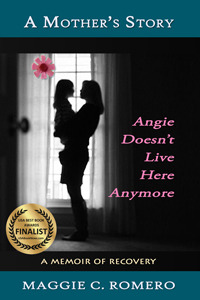
My daughter is a drug addict, in and out of recovery for fourteen years. We are completely estranged right now. Many of us know the pain of that kind of loss, where our addicts are alive but not in our lives. Yet I also have two happy children and two wonderful grandchildren. I have more years behind me than ahead of me, and I want to make the most of my life now. I choose not to count my losses, but to celebrate my blessings. I choose joy.


Mountaintops

Memoir Excerpt:

“Hi Mom. Guess where I am! My sponsor took me on a ride on a tram in the San Jacinto Mountains! It’s gorgeous up here. I can see for miles and miles.”

“Thanks for calling, Angie, and sharing this with me. I love you!”

I always ended our communications with those three words. Even if we were fighting, and the words got ugly, I made sure she knew that I loved her. I no longer took for granted that this was just another phone call. I never knew if this was going to be the last one. High up on the mountain with her sponsor, could they see what was coming? In the movie Out of Africa, Karen Blixen said, referring to her imminent illness, “The world was made round so that we couldn’t see what was coming down the road.” And that’s a good thing. How would our lives be altered if we all had a crystal ball?

That summer I wanted her to come visit and see our farm in the Southwest. In she flew from sunny Palm Springs to sunny New Mexico, and it was a joy to have her with us for a few days. Angie is, among other things, a very talented artist, and I asked her to paint a little sign naming our farmhouse Casita del Mar, so named because of my huge shell collection. It still hangs on the post in my front courtyard, though in the years since her visit it has sustained a lot of weather damage.

We had fun, tooling around Santa Fe, and visiting the Georgia O’Keeffe Museum. I knew she would appreciate seeing this artist’s work. Angie had a gift for expression, both in the spoken word and in her renderings. As a child she wrote a lot of poetry. She also could capture on paper a face or expression with great accuracy. In art school I was good at drawing elevations and brick walls, but I couldn’t begin to draw someone’s face. Angie had a great gift.

We continued north up the slow mountain road to the Taos Pueblo, where we visited a potter we knew and bought some more of her pieces. The next day we took Angie up the tram on Sandia Crest, where you can see for miles in three directions. Looking out for hundreds of miles—and looking within. I knew I was doing a lot of that in my own recovery, but Angie never shared her recovery work with me. On our last day together we celebrated her birthday at dinner in Corrales. Of course, she had to get back to work. We hugged at the airport and said goodbye. Again, there were so many goodbyes—so much uncertainty. I will never allow complacency into my life again. I will never, ever, take a moment of happiness for granted.”


Grateful To Be Growing Within

From Sharing Experience, Strength and Hope, June 16:

“I remember feeling my anger and resentment lessen at my first meeting when I learned that addiction is a disease, like cancer or diabetes. I didn’t cause it, I can’t control it and I can’t cure it.

Today I am grateful that I am married to an addict because I have been given the opportunity to explore my spiritual nature and move out of my comfort zones. I have taken a good look at who I am, what I want and where I’m going. I am facing my past, my faults and my fears. I am becoming a better person, a happier person, and a more serene person. I am slowly but surely learning not to suppress my emotions and fears, but to release them and grow.”

‘No longer forward nor behind I look in hope or fear. But, grateful, take the good I find, the best of now and here.’  John Greenleaf Whittier

Just for today, I will pay attention to my blessings. I have so much to be grateful for, and I guard against complacency. It can all be snatched away in a heartbeat, so I take nothing for granted. This is a good way to live, savoring every good moment.

“Nana, Do You Believe In God?”

Memoir Excerpt:

“Xavier and I had spent a lot of money on rehabs. But it didn’t matter. I’d already hurt my health, ended my career. But none of that mattered to her. The only thing that mattered, the only thing, was her willingness to do what was necessary to get well.

If she had had cancer, and the doctor said she needed chemo to get well, she would have needed to go for her chemo treatments. If she’d had diabetes, and needed insulin to stay alive, she would have needed to take insulin. She held all the cards, all the passports, to a healthy life, the life her parents had dreamed for her when she came into the world. But could she do it alone? I didn’t believe so. Some addicts recover without having faith in something outside of themselves; they rely on willpower, among other things. Faith in God or any “higher power” is, for many addicts, a difficult idea to embrace. And Angie, ever since she was little, had been a confirmed atheist.

In 1987 when Angie was eight, she was visiting my mother in Massachusetts. She adored her Nana, and confided in her things that I didn’t know about. During one of these chats, Angie said,

“Nana, do you believe in God?”

“Well, of course, Angie, don’t you?” my mother responded.

“NO I DON’T, NANA, NOT ONE BIT!”

My mother, before she died, used to love telling me that story. She was tremendously amused by Angie’s stubbornness and independence. But now, at this point in her life, Angie needed faith more than anything, because whatever she was using up to this point was having no lasting impact on her recovery. In the Program, they define insanity as “doing the same thing over and over again, and hoping for different results.” Well, flooding your brain with dangerous drugs clearly does make you crazy, temporarily or otherwise. Angie needed to change course if she was going to get well. She needed to do things differently. But what I realize now is that what she chose to do and how she chose to do it was/is out of my hands.”
Happiness Is A Choice

15 Things You Should Give Up To Be Happy

1. Give up your need to be always right.

2. Give up your need for control.

3. Give up blame.

4. Give up your self-defeating self-talk.

5. Give up your limiting beliefs.

6. Give up complaining.

7. Give up the luxury of criticism.

8. Give up your need to impress others.

9. Give up your resistance to change.

10. Give up labels.

11. Give up on your fears.

12. Give up your excuses.

13. Give up the past.

14. Give up attachment.

15. Give up living your life to other people’s expectations.

Expectations

Memoir Excerpt:

“In recovery, we learn to profoundly adjust our expectations, hard as it is. We raised one child, and now we have another. We are all too aware of the change that drugs have produced in our children. A parent wrote in Sharing Experience, Strength and Hope a very revealing statement, something I could have written myself. It is a key to understanding my story, my mother and father’s stories, and my daughter’s painful struggle:

‘I expected my children to be perfect, to always do the right thing. I tried to control them by giving them direction and making them do things in a way that I felt was correct! When they didn’t, I could not handle it.

I could not accept their drug use and I felt that their behavior was a reflection on me. I was embarrassed for myself and scared to death for them. I became so distrusting of my children that I showed them no respect. I would meddle and invade their privacy looking for any excuse to challenge and confront them.

When I came to Nar-Anon, I learned that my interference and my attempts at controlling them were actually standing in the way of their recovery. I learned to let go of the control I never had in the first place. (29)'”

image

Silver Linings

From Courage to Change, January 11:

‘For me, alcoholism has proven to be a bittersweet legacy—bitter because of the pain I suffered, and sweet, because if it weren’t for that pain, I wouldn’t have searched for and found a better way of living.’ “Al-Anon Faces Alcoholism”

I try every day to hold onto the serenity I’ve found. I want that for all of us struggling through the despair of addiction. Praying we can find some peace in the midst of this cruel disease, through any means possible. Blessings to us all!

Buried Alive

Is the holiday season sometimes overwhelming to you?

From Courage to Change, December 8

“The image of an avalanche helps me to give the drinking alcoholic (or addict) in my life the dignity to make her own decisions. It is as though her actions are forming a mountain of alcohol-related troubles. A mound of snow cannot indefinitely grow taller without tumbling down; neither can the alcoholic’s mountain of problems.

Al-Anon has helped me to refrain from throwing myself in front of the alcoholic to protect her, or from working feverishly to add to the mountain in order to speed its downward slide. I am powerless over her drinking and her pain. The most helpful course of action is for me to stay out of the way!

If the avalanche hits the alcoholic, it must be the result of her own actions. I’ll do my best to allow God to care for her, even when painful consequences of her choices hit full force. That way I won’t get in the way of her chance to want a better life.

Today’s reminder: I will take care to avoid building an avalanche of my own. Am I heaping up resentments, excuses, and regrets that have the potential to destroy me? I don’t have to be buried under them before I address my own problems. I can begin today.”

‘The suffering you are trying to ease…may be the very thing needed to bring the alcoholic to a realization of the seriousness of the situation—literally a blessing in disguise.’ (From “So You Love An Alcoholic”)