A Family Disease

A Memoir of Recovery

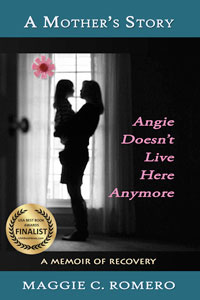
“Where might my daughter be now if fate, or genes, had been kinder to her? Now, several years into her illness, I am coming to terms with the terrible legacy that began generations ago in my own family and which I have unwittingly passed on to my daughter.  All these years I’ve diligently searched for answers, clarity, and solace in the face of terrible pain. Like a gift from the universe, it has come to me slowly, and it is with me now. But it’s been a hard won victory.

I liken the effect addiction has on families to a bomb exploding in the living room with everyone nearby.  The shrapnel hits us all in different places; none of us is left untouched, though some may be wounded more than others. Some even ignore the explosion or block it out as the insidious effects of addiction take root in these bewildered individuals.

What happens when a bomb drops anywhere? Doesn’t everybody run for cover? That’s what happened in my family. Angie’s brother and sister got out of the way as much as possible—a healthy response, I suppose—shrapnel wounds can be pretty dreadful. It broke my heart to see them pull away from their sister. But now Angie was so isolated in her family. And so began the long journey, Angie’s father’s and mine, of carrying her, much of the time, on our backs.” ~excerpt from my award-winning memoir, A Mother’s Story: Angie Doesn’t Live Here Anymore, by Maggie C. Romero, available on Amazon


I got an email from my old friend in Virginia whose son is a heroin addict. His sisters have nothing to do with him anymore. It breaks my heart to see the same thing happening in her family, and yet it’s very common. Families are swallowed whole into the belly of the Beast, spit out pieces at a time. Everyone is affected, and though people may try to deny the existence of a problem, or try running and hiding, there is no way to escape the effects of addiction.

Al-Anon and Naranon provide education, compassion, and tools to learn to live with this growing epidemic. We are not alone; we are no longer isolated. Addiction is everywhere. No more shame. No more silence.
Making A Difference

From “When I Got Busy I got Better,” p. 21

“After feeling so powerless while living unsuccessfully with alcoholism, I see now that I can make a difference. I’ve learned to let go of the things I cannot change and to work on changing the things I can. I’m ‘letting it begin with me.’ I ask myself: am I ready to make a difference?”


We can resolve to make a difference just about anywhere: volunteering in about a trillion different organizations in need of help; doing the dishes when your husband is too tired to; feeding your neighbor’s dog. Any activity that gets me out of myself is often time well spent.

We don’t always realize that the little things we do are making a difference in the lives of others. Someone said, “Service is the rent we pay for a space on this earth.” I like the spirit behind that quote because it reminds me to be less self-centered and remember the needs of others in need of help. When I do something for them, MY self-esteem soars. And in giving, we all know, we receive.

The Path To Peace

From Each Day A New Beginning, August 19:

“‘…to have a crisis and act upon it is one thing. To dwell in perpetual crisis is another.’ Barbara Grizzuti Harrison

Exaggerating the negative element in our lives is familiar behavior for all too many of us.  But this obsession is our choice. We can stop at any moment. We can decide to let go of a situation that we can’t control, turn it over to God, and be free to look ahead at the possibilities for happiness…Perhaps we can learn to accept a serious situation in our lives as a special opportunity for growth first of all, but even more as an opportunity to let God work in our lives.

Serenity is the gift promised when we let God handle our lives. No crises need worry us. The solution is only a prayer away.”

In my recovery program we are quick to replace the word “God “with “higher power.” A tree, the sunset, a friend—anything but me, because “my best thinking got me into the rooms.” The point of this reading is Step Three: turning our crises, burdens, whatever is too much for us, over to another being who is stronger and wiser than we are.

It took me a long time to take this step because I thought I was strong and wise; I didn’t know how to rely on others. My faulty thinking was: I’d better be able to handle all this cuz who else has ever helped me when I needed him?

Fortunately, I’ve learned to change my attitude about many things, including my ability to handle my life which wasn’t working for me at all! I’m grateful to have been unhappy enough, desperate enough, and finally open enough, to consider other options toward living better. And one of the most critical ones was turning an unbearable situation over to a higher power. The weight of the world was lifted off my shoulders, and I found a new freedom. I began to focus on my own happiness and well-being—because without it I wasn’t much use to my other loved ones.

Recovery has been all about self-care—from letting go of guilt, to putting an end to enabling, to accepting what I can’t change.

I do this because I’m worth it.

Resentment Hurts Us

When I feel resentment it’s uncomfortable, and I’m prone to want to stuff my feelings. But that’s never good for me. It’s an old bad habit that my years in the program have enabled me to give up.

I need to stay in tune with my resentments every day and deal with them constructively. Sometimes that means airing them; other times I need to bury them. Otherwise, they will come back and destroy me.

I’m so grateful to be able to look at negative behaviors and try to replace them with positive ones. It’s “progress, not perfection” that keeps me moving forward to calmer waters.

“Resentment is like swallowing poison and waiting for the other person to die.”


“Happiness Is An Inside Job”

From Each Day A New Beginning, September 30:

“What difference does it make how I am treated by life? My real life is within.” ~Angela Wozniak

“It is said that we teach people how to treat us. How we treat others invites similar treatment. Our response to the external conditions of our lives can be greatly altered by our perceptions of those conditions. And we have control of that perception…

The program offers us the awareness that our security, happiness, and well-being reside within. The uplifting moments of our lives may enhance our security, but they can’t guarantee that they will last. Only the relationship we have with ourselves and God within can promise the gift of security.

The ripples in my life are reminders to me to go within.”

When I rely too heavily on circumstances in my life, especially those over which I have no control, I’m setting myself up. It’s great when things go smoothly in my life, but often they don’t. When all is well, it’s natural to feel happiness and a sense of well-being. But I can lose that sense of security in a heartbeat when all is not well, when I am burdened by heartbreak. That’s when I’m grateful for the spiritual life I have at my disposal. When I remember to trust in my program every day, I’m able to feel God’s grace.

My daughter Angie has been in and out of addiction for fifteen years, and for many of those years I allowed her illness to destroy my well-being. I fought like a warrior mom to save her, as though her recovery were totally up to me. She was in and out of several rehabs, and my sense of wellness ebbed and flowed along with hers. This is codependence, an illness in itself. Thank you, Melody Beattie, for shining a light on this misunderstood malady!

I felt at first that letting go was dropping the ball, evidence that I didn’t love my daughter. Heaven knows, there were many people out there who were telling me that. But unless they’ve walked a mile in my shoes, they don’t know what they’re talking about.

I often say that attitude is everything. I have this sadness in my life; most of us here do as well. But I refuse to let it define me. I refuse to obsess about it any longer. My energy is better spent on all the other loved ones in my life: other family and friends. I want to use what’s left of my life in a constructive way: by sharing my experience, strength and hope with others in my book about Angie, my blog, and a second book, a sequel to the Angie story coming out next year. I also like to sing and go canoeing, hike and cross country ski.

Life is as full as I want to make it. How I spend my time now is more important than how I spent it in the past because I can build on the lessons learned from my mistakes. Life can be better now if I apply a positive attitude to my efforts and not be too concerned with outcomes. Expectations can be killers.

I try to loosen my grip on things in my life, take deep breaths, and relax. Life is unfolding as it was meant to.

The Pain Of Isolation

From “When I Got Busy I Got Better,” p. 12

“Recently I attended a neighborhood hearing to show support for a local service. To my surprise, I found myself taking part as an active and committed member of my community. My pre-Alanon feelings of isolation and frustration had abated as I established a connection with my neighbors…In tracing the development of my new experience of common ground, I realize that my years in Al-Anon had been instrumental in dispelling my isolation…A member of our fellowship once explained how reaching out in simple ways had helped her break through her loneliness, desperation, and isolation.”

Feelings of being an isolated outsider have shadowed me all of my life, and not just because I’ve traveled a lot. Many of my friends who grew up in alcoholism share the same experience of being different from others. I’m not sure why this is, but I do know that the work I’ve done in recovery has pushed me out of my shell, “my dark cave of depression,” and encouraged me to jump into life more, do more service work, get involved. In other words: shed my fear and take risks. Recovery is all a matter of perception, I often say here, and the world has opened up to me in new and different ways. I’m grateful not to be closed off to all the possibilities ahead. Life is good!

Embracing Our Freedom

From Each Day A New Beginning, April 1:

“‘It is only when people begin to shake loose from their preconceptions, from the ideas that have dominated them, that we begin to receive a sense of opening, a sense of vision.’ ~Barbara Ward

…The past that we hang onto stands in our way. Many of us needlessly spend much of our lives fighting a poor self-image. But we can overcome that. W can choose to believe that we are capable and confident. We can be spontaneous, and our vision of all that life can offer will change—will excite us, will cultivate our confidence…We can respond to life wholly. We can trust our instincts. And we will become all that we dare to become…Each day is a new beginning. Each moment is a new opportunity to let go of all that has trapped me in the past. I am free. In the present, I am free.”

I’m not on automatic pilot anymore. My step work has helped me know myself better, be accountable for my actions, make amends when necessary, and move on. That last one is critical: moving on. When I get stuck on something, my sponsor in the program helps me shake free of it. Get unglued. Life is too short to bury myself in the past that I can’t do anything about anyway. And tomorrow? Well, I could get hit by a car!

If I make an effort to stay in today, I have an opportunity to make “cleaner” choices and live better. At my age, that matters a lot to me. The three A’s are an important tool: Awareness, Acceptance and Action. I choose to act differently now. I have the freedom to choose.

I’m not in a coma…I’m an actor in my own script—not someone else’s. I feel tremendously empowered by this, taking control of my own life. Awareness has been a key in maintaining my emotional sobriety. And that awareness is reinforced all the time by the mirrors that surround us.

As a friend says when she shares at meetings, “Thank you for my recovery.”

Memories of Greece

A Memoir of Recovery


I’m finishing up my second memoir about addiction, a sequel to A Mother’s Story, but had to visit a major crossroads in my life first. My daughter Angie was ten when a big change occurred in our lives, and I needed to revisit Greece with a fresh perspective nearly thirty years later. Sending love to all my FB friends from the top of a volcano, Santorini, where they have internet and TV, lol!

Habits Can Be Unlearned

From Each Day A New Beginning, April 20:

“‘One has to grow up with good talk in order to form the habit of it.’ ~Helen Hayes

Our habits, whatever they may be, were greatly influenced, if not wholly formed, during childhood. We learned our behavior through imitation, imitation of our parents, our siblings, our peer group. But we need not be stuck in habits that are unhealthy. The choice to create new patterns of behavior is ours to make…We can find strength from the program and one another to let go of the behavior that stands in the way of today’s happiness. And we can find in one another a better, healthier behavior to imitate…I am growing up again amidst the good habits of others, and myself.”


I often say that I grew up in the rooms as well. I’m almost seventy years old, so that’s a lot of years to look at and take inventory. But I’ve learned to “look back without staring.” Not to obsess about things that are over, that I can’t change now. To let go of what’s past and focus on what’s right in front of me.

The tools I’ve picked up in my recovery program have been essential for guiding me into new ways of behaving—“acting my way into right thinking.” And doing things differently now—whether it’s eating right, power walking, or remembering to tell people I love them every day—are changing the way I think. And this, in turn, has the effect of elevating me—moving me away from old negative patterns that kept getting in my way.

It’s never too late to learn how to be happy.

Disease Or Choice?

I received these emails over a year ago:

“I am sick of hearing addiction is a disease! It is a choice! I have been clean/sober for over 20 years. I made a choice! I chose to put a needle in my arm. I chose to get drunk because I could not handle what life gave me. Then I chose to get clean and stay clean. Life is all about choices.”

And another: “Addiction is a disease. Recovery is a choice.”

I’ve entered into this debate many times, and I use this situation as an illustration:

A bunch of kids are at a party and heroin is offered. One kid experiments with it and can’t let it go. He gets hooked, looks around to get it, keeps taking it for the feeling it produces. He becomes addicted to it.

Another kid at the same party does the same thing, even likes how he feels when he takes it, but is able to heed the warnings he hears and makes a choice to walk away from it, never tries it again.

The first kid may have the addiction gene in him already and taking heroin just activated it. He didn’t choose to be an addict. He just was. But he still has a choice about recovering from his addiction.

The second kid doesn’t have the inclination toward addiction. That’s why it was easy to say no to it and walk away from heroin.

Both of these women who emailed me are right. I just think we all get bogged down in semantics.


On a more personal level, I see the difference in my own family. Both of my daughters have experimented with drugs. Sadly, Angie is an addict (passed down through four generations in my family).  Except for brief periods when she was in rehab, she hasn’t been able to walk away. My other daughter is not an addict and she doesn’t want to waste her life the way her sister has (Angie’s “choice”). I’m sad to be losing Angie to this terrible disease, but I’m thankful that my other daughter has been able to “choose” more wisely.